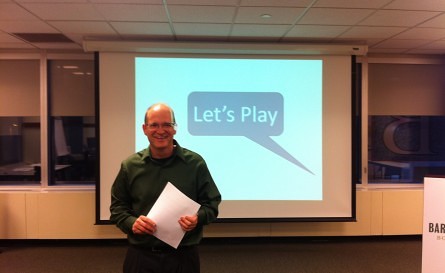
To continue the interview theme for another week, I present my interview with Karl Kapp. Karl is an eLearning expert, author, researcher and all round fountain of information and understanding!
Can you sum up what you do in a single sentence?
I teach, study, research, write, and educate others about the convergence of learning, technology and pedagogy with a focus on games and gamification.
How did you get involved with learning and helping people understand it better?
I discovered the field of instructional design my first year out of college. I was working for a company that happened to be an instructional design firm. Working for them changed my life, when I found out what the field was about and how it impacted people through carefully designed learning interventions, I wanted to be a part of it. When I found out about this field, I changed my graduate program of study from Educational Counseling to Instructional Technology and I haven’t looked back. I think the ability to impact learners through instruction is compelling and to do it with methods like games and gamification is even more exciting.
When did gamification show up on your radar?
Well, to answer this question, I went back to my blog to see that my first post with the word “gamification” was November 8, 2010. It was a post about Jess Schell’s Gampocalypse. But actually, I had been thinking about and writing about the concept for some time. I knew that learners could benefit from elements of games integrated into instruction but I didn’t have a catchy word for it. In fact, I had written about game-based elements for learning in my 2007 book, Gadgets, Games and Gizmos but didn’t have a jazzy term for it. So when I heard the word “gamification” I knew that was the term I could use. Not everyone likes the term but it sums up the idea of using game elements in traditional instruction pretty well.
How do you see games and gamification (remember our comment discussion on the difference a while back) affecting education in the next few years?
Games for learning and gamification appear to be gaining momentum in the learning industry and I do not see a slowdown in growth. Several elements are converging to spur this growth. First is that the technology used to create learning games and gamification experiences is becoming more accessible. It is still difficult to program a high level game and all of the associated artwork but it is 10 times easier than it was just five years ago and in another five years it will be even easier than today. So the technology is making it easier to create high quality learning games.
Second, the current generation entering the workforce has grown up playing video games. They are familiar with the conventions of video games, they play video games on their mobile devices and they are not opposed to using video games for learning. They understand that the medium of learning games can help them learn because they have learned by playing games. They are also expecting more “fun” in every day interactions so elements of games added to every day experiences like driving a car or paying for gas are expected to be more “game-like.”
Third, the research-base for game-based learning is finally starting to grow. Previously there was little focus on games for learning aimed at adults in the research literature. However, the combination of the first two items has generated an entire focus on the area of studying games for learning and the existing research to date has been positive for the impact of games for learning. Gamification still needs some more research to determine when it can be most effective but there are a number of elements underfoot in that area.
Fourth, games have the added element of replayability. Most people would not want to sit through a typical classroom lecture or online learning module again and again and again. Yet, these same people will play a game over and over. Games provide the chance to practice and hone skills because the learner wants to engage with them time and time again because they have elements that lend toward replaying scenarios or situations and observing the outcome. Gamification, if done well, will propel people through content and help them cover material more effectively by knowing what is of value by the difficulty of earning the points or badges.
But keep in mind games and gamification for learning still encounter resistance and this is because the people resisting don’t understand that well designed games or a gamification event contain all the best learning design: they start easy and allow the learner to gain skills as they go, this is the pedagogical element of scaffolding, they provide models of desired behavior, this is Bandura’s Social Learning Theory, when played over time, they use the concept of Distributed Practice, they provide Targeted Feedback and they allow the learner to employ all the elements of Self Determination Theory which are autonomy, relatedness and mastery. Games and gamification events when designed correctly, are the perfect vehicle for learning and that is why I think the future of games and gamification for learning is expanding.
Do you see value in gamification outside of education? Read More ...