Leaderboards: The Good, The Bad and The Ugly

Leaderboard Leaderboards The Good The Bad and The Ugly

Leaderboards have been a staple of gaming and gamification for as long as both have existed. From Space Invaders, to baseball, to your gamified CRM system – all have had leaderboards in there somewhere.

The reasoning goes “if you are the top, you feel special and if you are at the bottom, you don’t want to be there so are motivated to improve”.

It sounds great, doesn’t it? Instant engagement. DO well, feel special. Do badly, be motivated to do better. In some cases, this is can be the case. In sports, it is a way of knowing where a team is in the league and how many points they need to improve by. In space invaders it was a way to create a more social or even personal challenge in the game, helping to create that “one more go” feeling. If I have one more go, I know I can be better than AAA or myself. Read More ...

The Mercenary User Type

With the news that a hacker group is using gamification to try and get people to engage in DDoS attacks, I got to thinking about what type of user may wish to engage with this.

Initially, the Disruptor sprang to mind, more specifically the Destroyer type. They act on the system to disrupt it and normally for not very nice reasons! However, there was an issue. Disruptors are self-motivated, they are not there for reward as much as recognition or just plain mastery and enjoyment. So using points and prizes to coerce a disruptor behaviour actually sits more in line with the Consumer type in the Player section of the Hexad. Read More ...

Exploring the Meta-Rules of Play

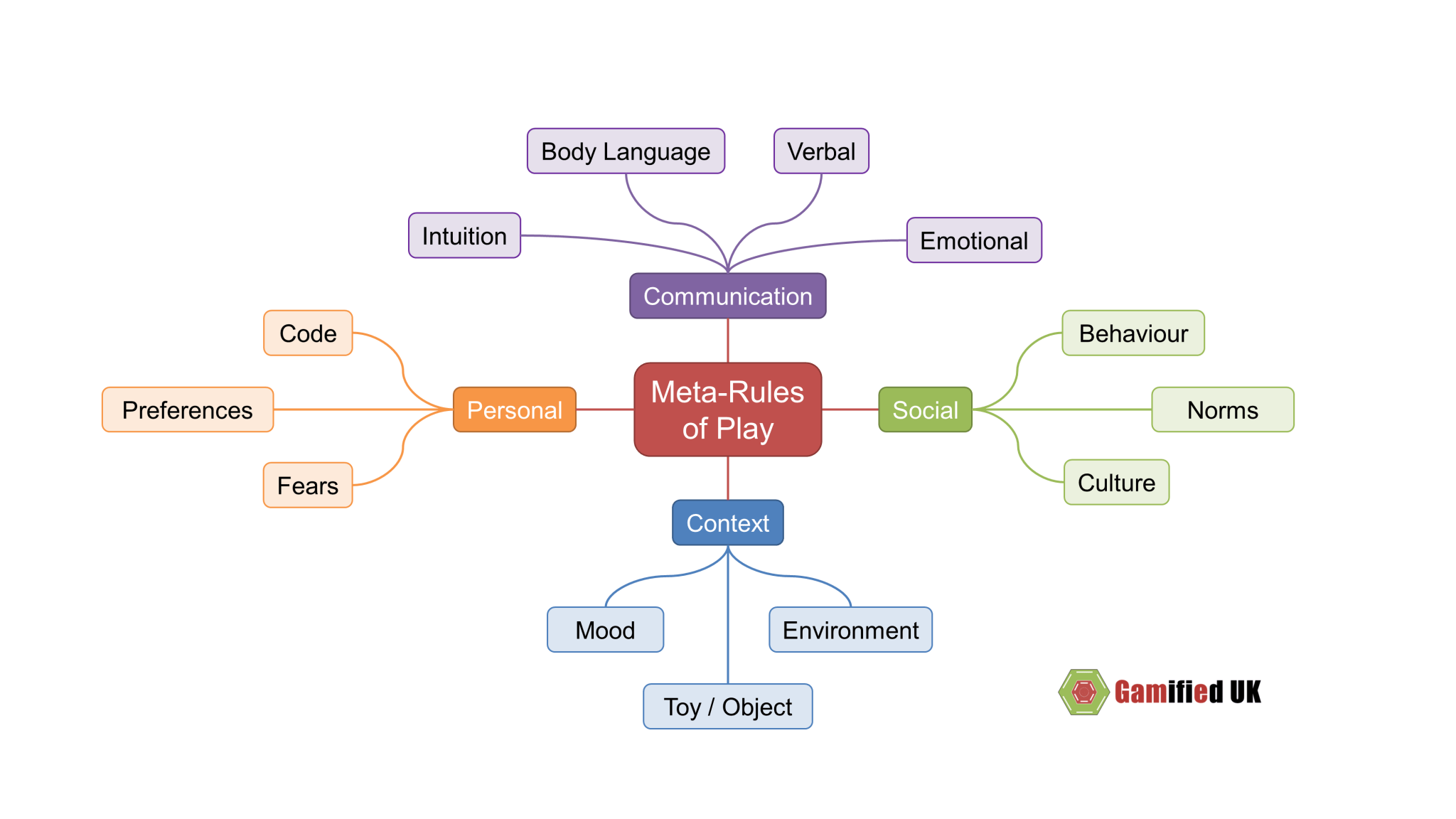
In my last blog, I introduced the concept of Meta-Rules. These were the non-system or inherent rules that actually guide how people play.

I spoke about them rather abstractly, describing them in the following way

These [meta-rules] rules are beyond what you would consider written or system imposed rules. These are fluid rules that can change moment by moment. These are the rules that define how play unfolds. These are the unspoken rules that children manage to communicate to each other when they are playing, where the situation is constantly changing, but they always seem to be able to adapt to the changes without fuss Read More ...

Playing with Thought Experiments and Meta-Rules

No great insights into gamification in this post, more me revisiting play, toys and games – again. When I need to clear my mind of clutter, I tend to consider the nature of play. That is probably why I write about it so much! I doodle about it on the plane, at night, when I have time to kill. I always come back to play. Dutch, a friend of mine in the gamification world likened it to Einstein’s “thought experiments”. Of course, I am not comparing myself to Einstein. The only things we have / had in common is dyslexia and a love (at one time) of physics. Read More ...

Gamification as a Strategy

The world loves a good aaS. Software as a Service, Platform as a Service, Cloud as a Service. Everything these days seems to be “as a Service”. That means, of course, that Gamification platform providers have started to speak about Gamification as a Service. Now, there is nothing wrong with this, though I do find some juvenile amusement at the acronym of GaaS. For me, it just smacks of making it easy for people to implement gamification really badly!

Hear me out. I have nothing against being able to use gamification in a simple way. You will see Gamification as a Service on this site in the form of Captain Up. I have not implemented it brilliantly, it is there for those who want to see it and can be ignored by those who don’t. It actually goes against some of my core messages about designing gamification in from the start. However, there is something to be said for being able to just paste a line of javascript into a page and have gamification up and running straight away. If nothing else, it gives people the opportunity to get involved. Read More ...

Exit mobile version