The Cost of Cute: When Your Gamification Stops Serving Its Purpose

File 000000001fd871f5b26dee2f9781c1d1 The Cost of Cute When Your Gamification Stops Serving Its Purpose

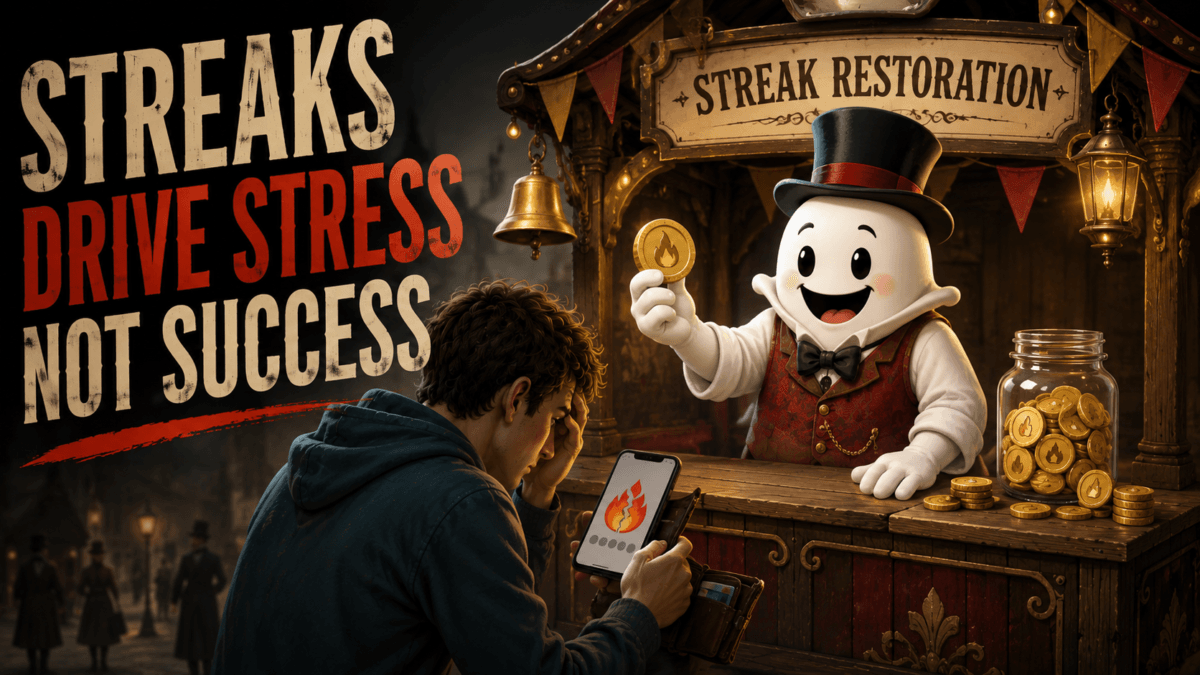
Recently my friend David Chandross wrote a great post about how serious games often miss their purpose, becoming more game than serious if you will. That it’s becoming less and less about the learning. That inspired me to reemphasise something I wrote about a while back.

Gamification should help people do things better. That’s it. But somewhere along the way, too many designers decided that the point was to make people play their systems, rather than benefit from them.

It’s easy to spot. You open an app or a training program and you’re immediately pulled into some shiny loop of collecting things, hitting targets, and chasing streaks. The problem is, you’re no longer learning or improving, you’re just playing. The system has become the goal. Read More ...

Your Cart Abandoned You For a Reason

Abandoned cart emails are one of those things that sound almost too obvious. Someone puts a shiny new kettle in their basket, forgets about it, and you gently nudge them a day later with an email that says: “Hey, you forgot something.” Simple. Effective. And for retailers, often the lowest-hanging fruit on the tree.

But then, a few days later, things get weird. Suddenly, the kettle has developed friends. Now your inbox is full of toasters, microwaves, sandwich makers, and possibly even a smug little milk jug. Somewhere in the retailer’s system, a switch has been flipped from “remind” to “relentless.” Read More ...

Dynamic Narrative Analytics: Turning Player Data Into a Playable Story

One of the greatest lies we’ve told ourselves in gamification (and business in general) is that numbers speak for themselves. They don’t.

Numbers sit there, mute and smug, like a cat perched on a bookshelf—daring you to make sense of them. And like a cat, they’ll let you project whatever meaning you want onto them… until you get scratched.

That’s where Dynamic Narrative Analytics (DNA) comes in.

This isn’t about algorithms. It’s not about drowning in dashboards. It’s about recognising that every dataset tells a story—and if you don’t write the story, someone else will (probably in PowerPoint, with clip art). Read More ...

Dynamic Narrative Analytics: The DNA of Data

Over the years, I’ve looked at a lot of numbers. Far too many really. Like many of us, I’ve struggled to keep my head above the surface of massive pools of data, desperately trying to understand what the floating numbers are trying to tell me. Excel straining, my sense of self dissolving, the what is often staring me in the face, but what I’m missing is the so what?

The fundamental challenge of the modern workplace is that data, in its raw form, is mute. A number on a screen has no context, no history, and no motivation. Yet we project onto it the weight of being an “answer.” We present these silent numbers in meetings and expect them to drive brilliant decisions, but they often fall flat, creating more confusion than clarity. Read More ...

Why it’s critical that AI is critical

It had to happen, I had to start writing about AI eventually. Why? Well, chatGPT is the ultimate gamification – a choose your own adventure with infinite outcomes!

I wanted to start with what AI is really bad at – being critical.

I’ve been using AI extensively over the last 12 months as a writing assistant, co developer and general wall to bounce ideas off, and I’ve learned a few things. First and foremost – AI is the best and worst cheerleader.


Everything you do is greeted with “that’s an amazing observation” or “what a great and insightful question” or “yes, this work is perfect, you are incredible”.
It like a constant stream of affirmation spewed out like shit from an incontinent dog,.but it is addictive. Suddenly, you are always right – how often can you say that in your day to day life 😉

It might make you feel great, but it also makes you miss critical issues with what you are doing. Rather than critique, you are getting confirmation of your own preconceptions. By default, things like ChatGPT wants to please you. This kills critical thinking, like having your own personal yes man that empowers all your worst ideas.

When you are working with AI, you need to set boundaries. You need to tell it to be critical, to analyse and assess what you are doing for merit and for being just plain shit.

I actually created a chat bot through ChatGPT that was trained on all my work, then given a personality.  Ninja Monkey is sarcastic, dismissive and at times just plain rude. Bit, he does try to be critical and tell you the truth. If an idea is crap, he isn’t scared to tell you.

This is essential, as it has helped me write better content, but assessing and checking my ideas and critically considering it for it’s true merits – not just waving a pompom and saying “you are awesome, go you!” He’s more likely to threaten to slap me with a pair of nunchucks.

Hell of you tell him you’re Andrzej, he may even insult you! Read More ...

Exit mobile version