


Games are hard.
Not always because the controls are complicated or the enemies are unfair, but because games often demand a surprisingly broad mix of skills.
Hand-eye coordination. Strategic thinking. Mental agility. Observation. Pattern recognition. Multitasking. Memory. Timing. Patience. Adaptation.
In other words, many of the same skills required by real life, just turned up to eleven and occasionally involving dragons.
To help players understand how all these abilities are coming together, games use a range of systems to track development. These systems tell us where we are, how far we have come, what resources we have available and what might happen next.
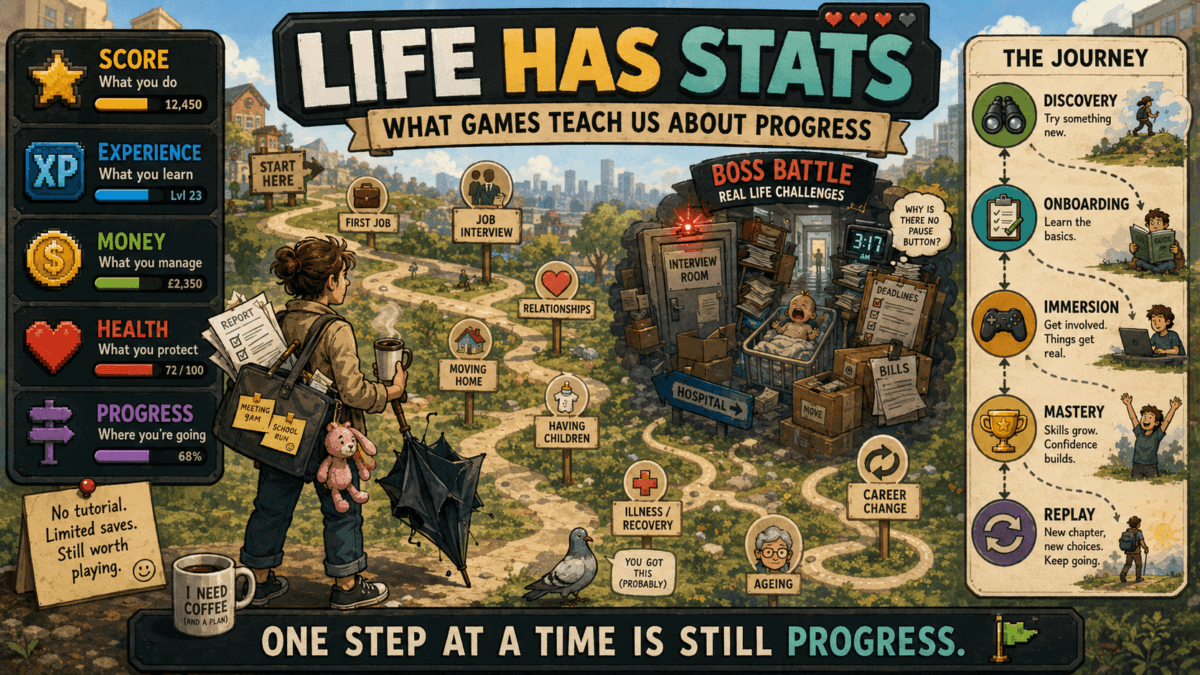
Score, experience, money, health and progress all give the player a slightly different view of their journey.
The interesting thing is that most of them have obvious parallels in real life.
Score: A Simple Measure of Success
Almost every game has some kind of score.
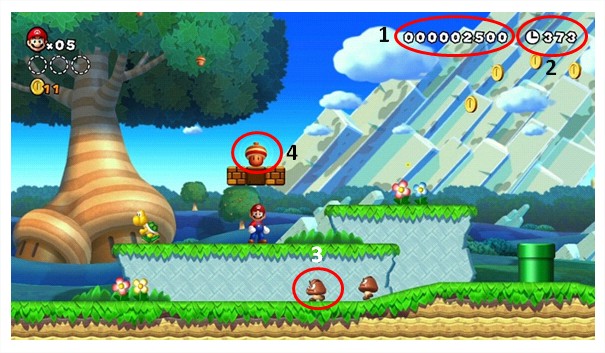
At its simplest, a score is just a number that increases when you do more of the things the game considers valuable. Defeat an enemy, complete a task, collect an item or perform an action well, and the number goes up.
It is simple, immediate and easy to understand.
Real life has plenty of score-like systems too. Salary is one example. Continue working, improve your performance and develop your career, and your salary will generally increase over time.
Of course, salary is not a perfect measure of success. It says very little about happiness, meaning, contribution or quality of life. However, it remains highly motivating because it supports some of our most fundamental needs, particularly security.
This sits within the base layer of the Three Layers of Motivation. Before people can focus on growth, purpose or mastery, they need to know that the basics are covered.
A score is useful, but it rarely tells the whole story.
Experience: Evidence of Growth
Experience points are another familiar way of tracking progress.
As players complete tasks, overcome challenges and explore the game, they gain experience. Eventually, that experience allows them to level up, unlocking new skills, abilities or opportunities.
Real-life experience works in much the same way, although sadly without a satisfying animation every time you become slightly better at Excel.
The more you practise, learn, fail, adapt and try again, the more capable you become. Over time, this experience opens doors that were previously unavailable.
You become qualified for new roles. You gain confidence. You develop better judgement. You become able to handle challenges that would once have overwhelmed you.
Experience reflects growth, and growth is closely linked to Mastery within the RAMP Framework.
Unlike score, experience is not just a measure of what you have achieved. It represents what you have become capable of doing next.
Money: A Resource to Manage
Many games also give the player some form of currency.
Money can be used to buy equipment, unlock upgrades, make difficult challenges easier or, naturally, purchase a completely unnecessary new outfit.
Unlike score or experience, money fluctuates.
You earn it, save it and spend it. That means the player must make decisions about priorities. Do you buy the basic equipment needed to survive, save for a powerful upgrade or spend everything on a diamond-encrusted battle axe?
Life presents much the same challenge, although most financial advisers remain oddly hostile to the battle axe option.
Money is not just a measure of progress. It is a resource that supports progress.
Managing it requires balance. Spend too little and you may miss opportunities. Spend too much and you may leave yourself exposed. The value is not merely in having money, but in understanding how and when to use it.
Health: A Resource That Must Be Protected
Health behaves a little like money.
In many games, the player begins with a fixed amount. During play, health is lost through mistakes, conflict, hazards and poor decisions. It can then be restored using potions, food, rest or medical support.
As players grow stronger, their maximum health may even increase.
Real life is more complicated, but the basic comparison still holds.
We begin with a certain combination of physical capacity, genetics and environmental conditions. Over time, our health changes according to age, behaviour, circumstance, illness and plain bad luck.
Sometimes health drops quickly. Sometimes it declines slowly. Recovery might require rest, medicine, doctors, therapy, changes in behaviour or support from other people.
Unlike many game resources, health cannot always be fully restored. It also tends to become more difficult to maintain as we age.
That does not make the comparison useless. It makes it more important.
Games teach us to watch the health bar before it reaches zero. Real life often encourages us to ignore it until warning lights are flashing and something has started making an expensive noise.
Health is not merely another statistic. It is the resource that makes all other forms of progress possible.
Progress: The Journey Itself
Then there is progress.
New levels. New areas of the map. New abilities. New challenges. New characters. New discoveries.
In real life, progress might appear as a new job, a relationship, a skill, a home, a personal revelation or a change in direction.
These moments are often what everything else is working towards.
Score tells us how well we are performing.
Experience tells us how much we have learned.
Money tells us what resources we can access.
Health tells us whether we can continue.
Progress tells us where the journey is taking us.
This is why progress is one of the most important forms of feedback in any system. People need to see that their actions are leading somewhere meaningful.
The User Journey helps us think about this over time. Discovery, onboarding, immersion, mastery and replay are not just stages in games or gamified systems. They are patterns that appear throughout life.
We encounter something new. We learn how it works. We become absorbed. We gain competence. Eventually, we either move on or find a reason to begin again.
Boss Battles: The Moments That Test Everything
Most games do not let you wander around collecting experience forever.
Eventually, you meet a boss.
A boss battle tests whether the things you have learned actually work together. Your timing, judgement, patience, resilience and ability to adapt are all pushed at once.
Real life has boss battles too.
A job interview can feel like one. You prepare, learn the patterns, rehearse your responses and try not to panic when someone asks where you see yourself in five years.
Having children is another. There is no meaningful tutorial, the objectives change constantly and sleep becomes an increasingly rare collectible.
Other boss battles might include moving house, changing career, getting married, ending a relationship, dealing with illness, caring for someone you love or facing a major loss.
These events are not simply points on a progress bar. They are moments when your accumulated experience, resources, health and support systems are all tested at once.
And like boss battles in games, they are rarely won through one skill alone.
You may need knowledge, but also patience.
Confidence, but also humility.
Preparation, but also the ability to improvise when everything goes wrong.
You may even fail the first attempt.
That does not mean the experience was wasted. In games, failure teaches you the pattern. In life, failure often reveals what you need to learn, what support you need and what you should do differently next time.
Boss battles mark transitions. They are the points where one stage of life ends and another begins.
You do not always emerge stronger. Sometimes you emerge tired, bruised and slightly confused.
But you emerge with more experience.
Games as Reflections of Life
Games reflect life in many ways.
They compress complicated ideas into systems we can see, understand and interact with. They make progress visible. They help us understand resources, trade-offs, risk, recovery and growth.
They show us that score is not the same as experience.
That money is useful but temporary.
That health must be protected.
That boss battles test more than one skill.
And that progress does not always happen in a straight line.
It would be naïve to dismiss games as meaningless distractions. They are models of challenge, learning, failure and development.
They may not perfectly reproduce life, thankfully, because most of us are poorly equipped for boss battles involving actual fire, but they can help us understand it.
The real lesson is not that life is a game.
It is that games give us a language for recognising how life changes, how we grow and how we keep moving forward.
Watch your health.
Manage your resources.
Learn from experience.
Do not confuse score with success.
Prepare for the boss battles.
And when progress feels slow, remember that moving forward by one step is still progress.
Similar Posts:
- Final Fight and Relative Progress Bars
- Mario as a Metaphor for your Career
- Progress: Central to Gamification


Also published on Medium.