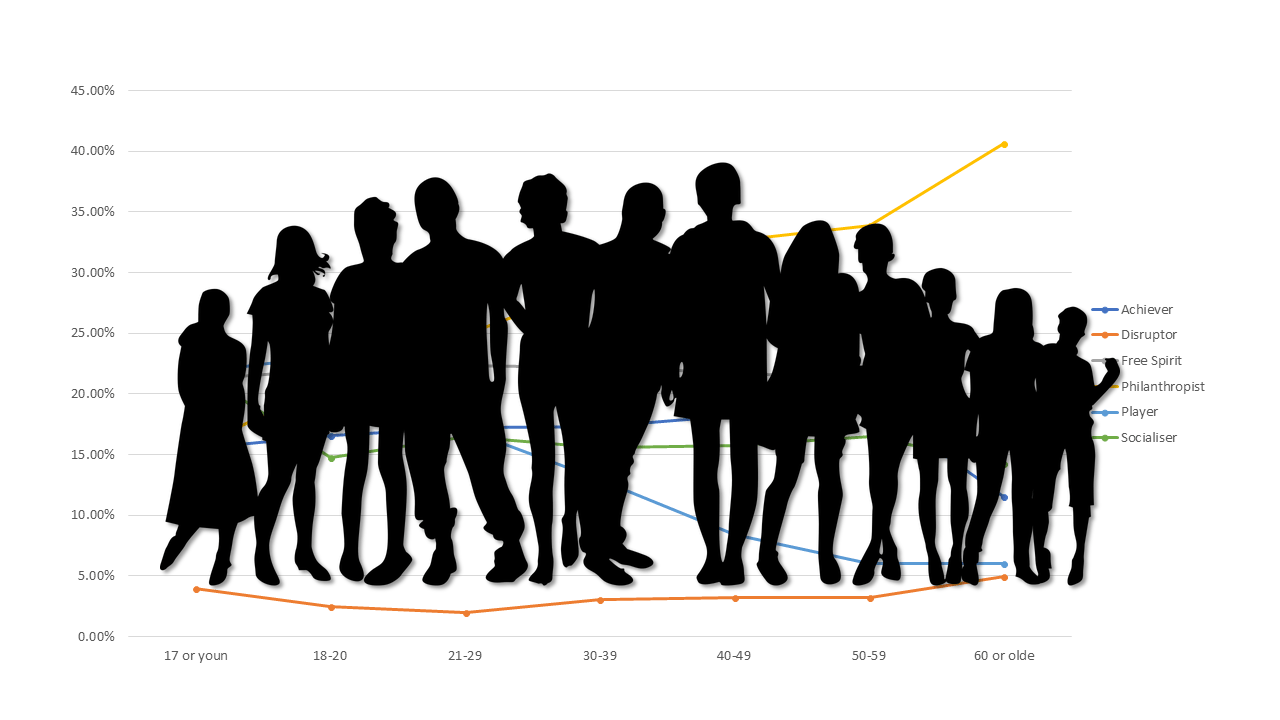
Considering Age and other factors in Gamification

Diersity Considering Age and other factors in Gamification

When speaking to people about gamification, I often hear comments along the line of “Yeah, but games are only for kids”, or “Yeah, but the age groups who work here are not interested in games”.

What is very nice these days, is how easy it is to dispell these myths with statistics (yeah I know, Lies, Damned Lies and Statistics).

Roughly (I say this as this is coming from multiple sources and 2017 quarters), in the UK, 43% of people aged 6-64 say that they play video games in some form. Of that group, 57% are male, 43% female. If we consider that working age is around 18 to 60 (ish), you are looking at about 78% of the total gaming group are potentially playing games., peaking around the 25 to 44 age group, but still significant in the 44 to 64 age group. Read More ...

Learning From Games: Space Invaders – Simplicitas est Perfectum

To this day, Space Invaders is one of my all-time favourite games.  Born the same year as me (1978), it is a classic in every sense of the word.

What I love is the simplicity, There is no heavy backstory, there is no complicated power-up system, no fancy boss battles or in-game purchases!

The instructions whole scene was set in one line of the four lines of instructions.

Game ends when players “Laser Bases” are all hit by invaders missiles or when invaders overun the base.

Simple as that! In one line of text, you know everything you been to know. You control a laser base and you need to defend it from the invaders. You quickly learn that there are some building you can hide under, but they can be destroyed and that from time to time a bonus can be had from hitting the mothership style alien. Read More ...

My Mental Health and How Gamification Has Helped

It is mental health awareness week, so I felt this would be a good opportunity to share with you one nugget of life strategy that gamification helped me learn.

I have made no secret that I have suffered from anxiety and depression most of my life. These have, at times, crippled me in ways that those without the issues find hard to understand. The truth is that no matter what strategy you may think you have, the first step is always to accept help. Easier said than done, but it is essential. No one should or can go through it alone and come out the other side in one piece. Read More ...

Practical Play Framework

Serious games and serious play both have an issue. The issue is, the word serious. It sounds far too, well, serious!

I have heard lots of people complaining about this, somewhat misunderstanding what the serious refers to. “Why can’t it be fun, not serious?” “Serious does not sound fun, that can’t be right!”

Obviously the serious in these terms is there to differentiate entertainment focused and non-entertainment focused games. That is to say, games that we play just to enjoy the experience and games that we play to achieve something, such as learning and skills acquisition. Read More ...

Gamification: Is Activity as good as Engagement?

Gamification is often accused of creating activity rather than engagement. Whilst this can be true, is it a bad thing?

First, let’s look at the difference between activity and engagement. Engagement is very hard to define and has plenty of definitions out there. For our purposes, we will consider it as a state where a person is voluntarily participating in an activity with commitment, without the feeling of being forced or coerced into participation. It is heading towards them “wanting” to participate. Read More ...

Exit mobile version