



I have been pleased to call David Chandross a friend for a couple of years now. We “met” through our shared love of games and gamification over Twitter and Facebook. Since then I have come to know him as a fierce proponent of using games to help people learn and gain a deeper understanding of topics in the healthcare industry. Not a man who backs down from a fight, I have had my share of arguments with him, but his intelligence and depth of knowledge always impress me. I wanted to learn a little bit more about him, so asked him if I could put out a short interview with him. Please read and enjoy! If you want to get in touch with him to find out more, drop him an email dchandross@ryerson.ca.
Gamification
Do Things Just Because They Amuse You

Anyone who knows me, knows that I often do stuff simply because it amuses me. A good example of that is the title of my book, Even Ninja Monkeys Like to Play. I went through dozens of iterations whilst trying to come up with a name. In the book there is an official reason for the name – which is partially true. My daughters crazy imagination and desire to be a pink unicorn with wings was the key inspiration for the name. However, there is another less obvious and far less grown up reason.
Not long before, I wrote the book, I was trying to work out a way for people to be able to reference the User Types Hexad in academic papers. A few people had issues referencing from a website, turns out the academic world is not so keen on blogs. Anyway, I decided to write a paper and submit it with a little help. Long story short, the paper was rejected. In a wonderful leap of circular logic, the fact that the user types were already on my blog, meant they were not original work and so a paper was not an option. Whilst trying to figure out another plan, I was told that often it was far more acceptable to cite a book than a blog. So, I decided to get the book done.
Gamification: Meaningful Choice


Heavy Rain. That was the name of the game that first made me understand that meaningful choices could take a game to new levels of immersiveness.
If you have never heard of it, Heavy Rain was a PS3 exclusive in 2010 from game makers Quantic Dream. You played the roles of several people through a convoluted mystery. There was the father who had lost his son, the private eye, the reporter and the FBI agent all linked to the mysterious Origami Killer. As the story unfolds, you have to decide how each character acts, how they handle conversations and what choices they make.
“If This Then That” Logic in Gamification


One of the things I love about coding is the simple logical basis that it is all built on. A lot of it can be boiled down to four simple words: If This Then That. If a condition is met, then do something.
There is obviously more to it than that. We have And, Or, Else, ElseIf, When etc, but the heart for me is If This Then That.
For example, in a game, you could have
- IF player presses a button (THIS) THEN make the player jump (THAT).
- In gamification, you could see IF user gets 500 points (THIS) THEN give user badge (THAT).
Of course, we can expand on that sort of logic with the operators I mentioned before.
Gamification: What’s Play Got to do, (Got to do) with it?

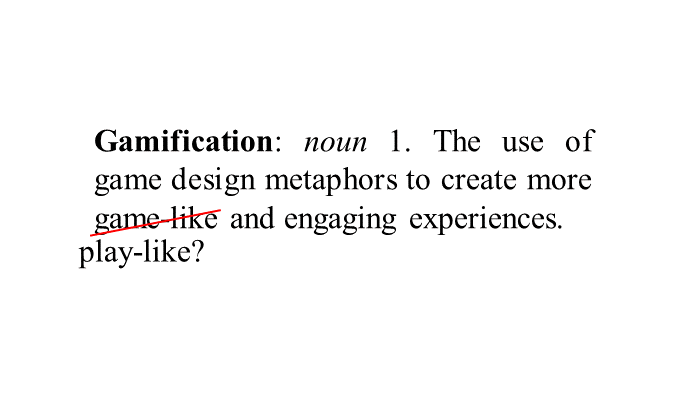
When I was researching my definition of gamification, I had a few major dilemmas. One of the main ones was the use of Game-Like over Play-Like.
Just as a reminder, I define gamification in the following way:
The use of game design metaphors to create more game-like and engaging experiences
However, it was very nearly:
The use of game design metaphors to create more play-like and engaging experiences
I have spent time previously explaining how I see the differences between play and games, you can read loads more here. At it’s most basic, the difference revolves around rules and goals. Games have extrinsically imposed rules and goals, where play doesn’t (or, at least, has far less). It is free form in its nature and from the outside looks like it has no purpose (but of course it does!).