Signposting and Gamification

The Naked Gun I C U P 2 Signposting and Gamification

Sometimes, even the best people need to be pointed in the right direction. Signpost next actions to help smooth early stages of a journey. Use “just in time” cues to help users who are stuck.

Whilst autonomy and agency are vital for deep engagement, sometimes too much freedom can be a bad thing. Whilst gamification should be designed around the user, their needs and their experience, there are still stakeholder and business objectives. Creating an environment where a user can get lost benefits no one. Read More ...

Gamification Design Thinking

Another day another framework. This time I can’t really lay claim to it though. This is my interpretation of Design Thinking – a very well know framework! I have mixed it with a few well know lenses for innovation – again, nothing new. It is presented here just as an aid for those who may not already be using it!

First, here is the basic process of design thinking

 Step by step:

  • Define and understand the actual problem. Very often the initial brief does not hold the problem that needs solving! Question, question and requestion and if needs be, re-frame the problem totally.
  • Empathise with the various people involved. Design thinking is all about putting the user first. So consider what types of user you will have, this is not the same as User or Player Types, this is what people need from the system. Who are the users, why are they using the system. What does Mavis, 83 from Wales need compared to Dave, 23 from Leeds? Sometimes it is good to survey potential or current users to get an idea of who they really are and then come up with some average users to role play with! Also, don’t forget the stakeholders needs in this. What do they want to achieve by gamifying the system? How will they react to it and your ideas?
  • Ideate – come up with ideas! Propose solutions and then analyse them (more in that in a moment). This is part of an iterative process, at this stage though there is no right answer.
  • Experiment with the best ideas. Pretotype and prototype and do it again until you have something you think is worth taking forward.
  • Test your pretoype or prototype with the target audience and with the stakeholders. Iterate between testing and experimentation until you are ready to release at least a minimum viable product (MVP).  Amy Jo Kim has an amazing course on MVP development actually!

Whilst this is set out as a step by step process, actually it is iterative. At any point you could go back tot he start, but by the time you are into the experimentation phase, you should have a pretty solid idea of where you are going. Read More ...

The Challenge, Feedback, Reward Cycle

As I read more and more about what makes a game a game, it becomes more and more clear where things with gamification can and do go wrong. I am not trying to say that gamification and games are the same thing, they are not, but they do share similar qualities.

At their core, games share many common traits

  • Challenge
  • Learning
  • Pattern Recognition
  • Feedback
  • A safe environment to fail
  • Sense of reward

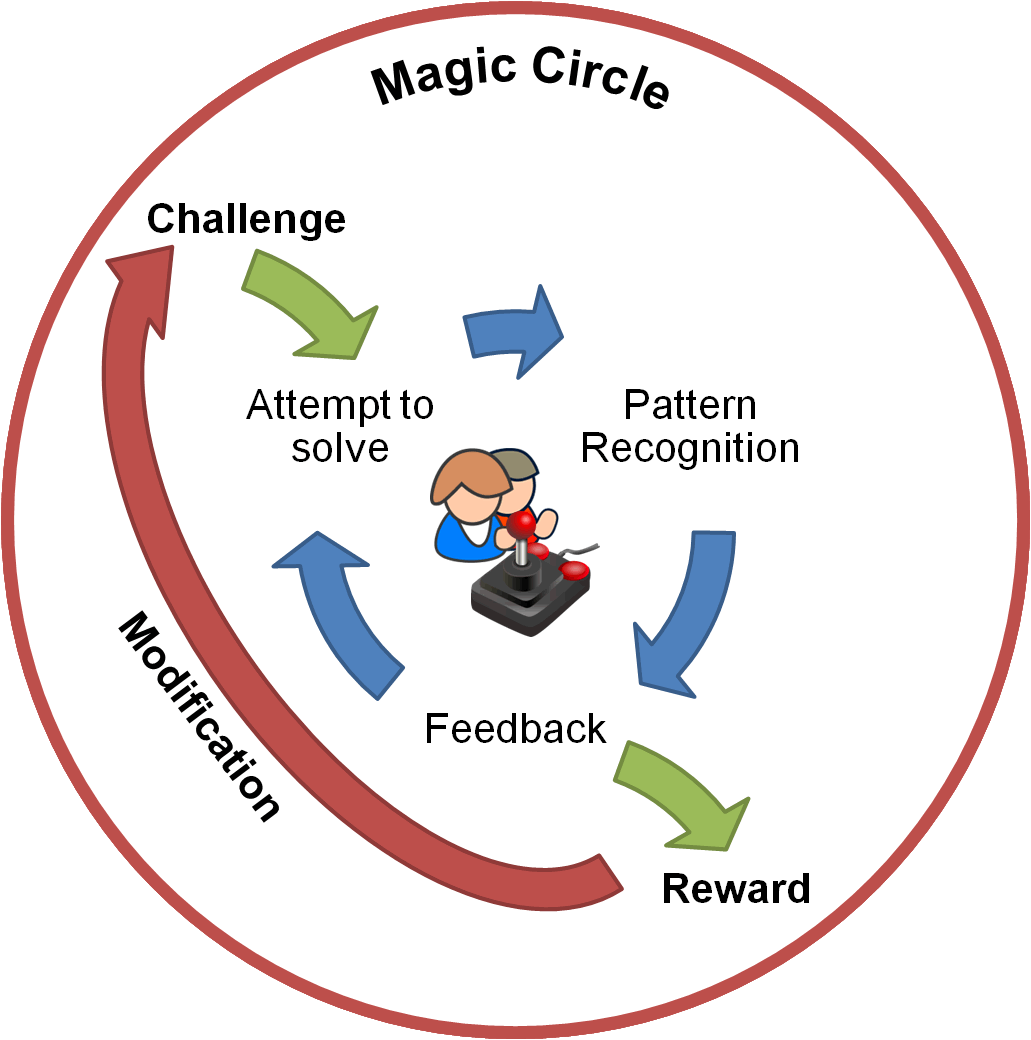
The Challenge, Feedback, Reward Cycle

The diagram below tries to capture this in a cycle (because I like pictures). For the sake of continuity, I am referring to the “Safe environment to fail” as the Magic Circle.

This is a gross over simplification of games and the systems that make them “fun”, but it will do for our purposes to illustrate some of the issues we may face in gamification! Read More ...

Easter Eggs and Gamification

Now, before you get excited – this is nothing to do with chocolate!

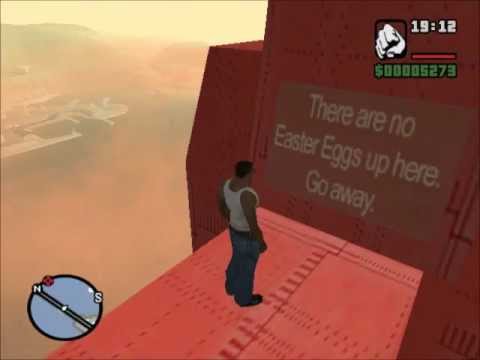
Easter eggs in this case refer to hidden surprises and extras (just like an Easter egg hunt when you were a kid). They are aimed at people who like to explore (Free Spirits) as they reward people for just looking around and digging a little deeper than some others.

In games (and actually even in serious software like Office), Easter eggs have been around for a really long time.

An Easter Egg doesn’t have to be hard to get too, Disney’s Aladdin had a lovely nod to Mickey Mouse for the more eagle eyed amongst its players. Read More ...

Gamification, delayed gratification and rewards

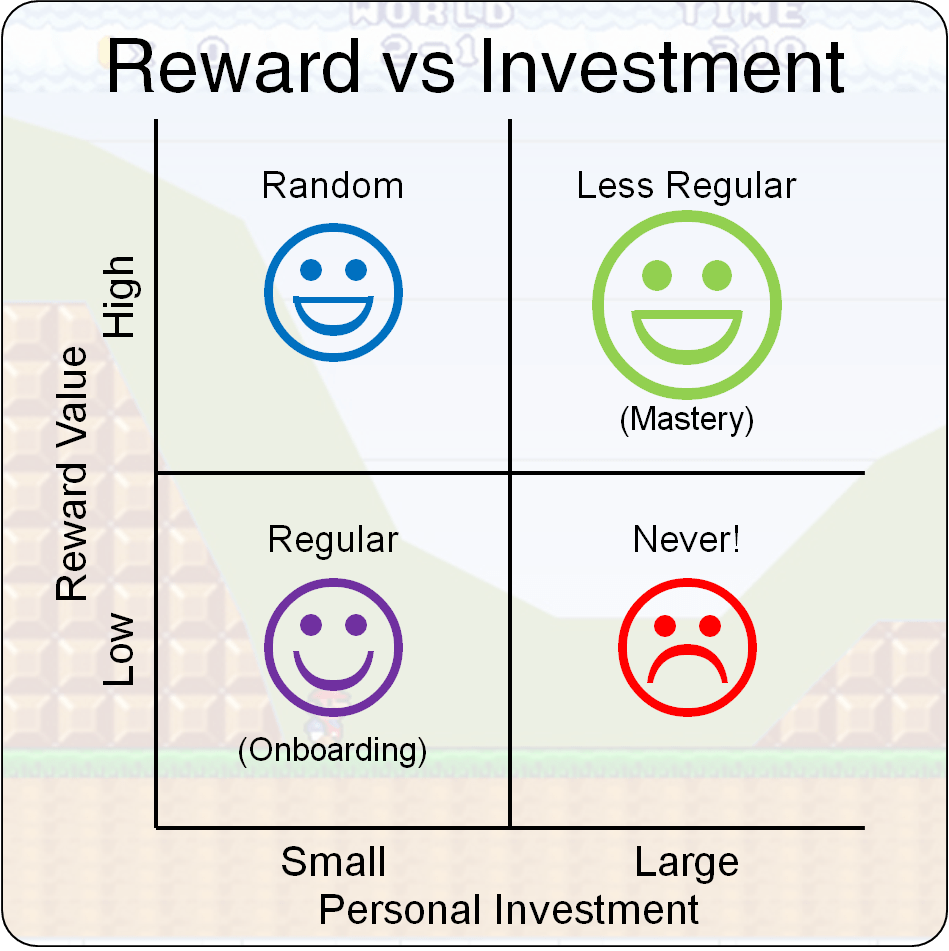
There has always been this common thought that if you have to work harder for something or you have to wait for it, the reward will be all the greater in your mind. Now for the most part. that is absolutely true. The anticipation of some sort of reward 1 is a massive trigger for dopamine and can make the reward all the more… well, rewarding – which we like!

The Marshmallow Test

However, not everyone is able to wait for a reward. There was a fantastic experiment in the 70s now referred to as the Marshmallow Test 2. The set up was that children were sat in a room and a marshmallow was placed on the table in front of them. They were given an offer. Eat this one marshmallow now OR wait until I come back and you can have two marshmallows. It is worth watching the videos if you need a smile! Read More ...

Exit mobile version