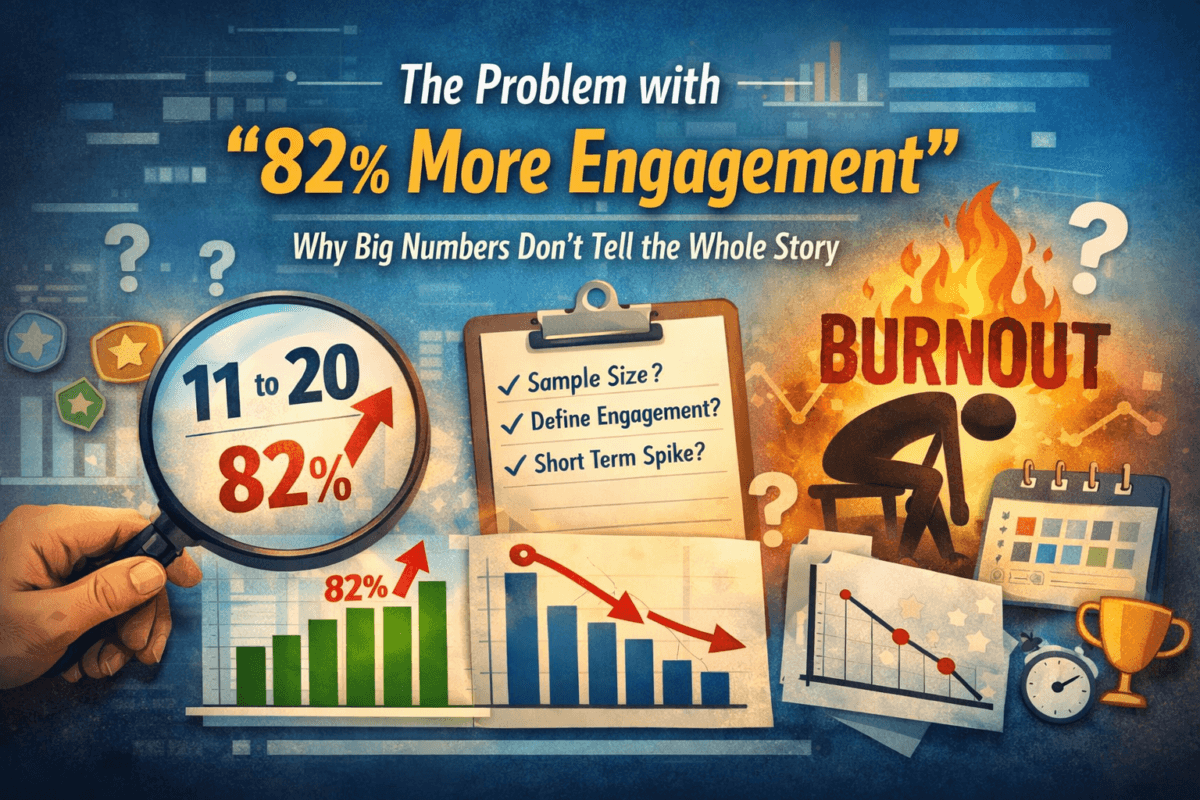
The Problem with “82% More Engagement”

File 000000001100722f8ee641db0e336e34 The Problem with 82 More Engagement

I love statistics. They are wonderfully effective at hiding the truth.

Gamification has been especially guilty of this over the years. We have all seen the headline:

“82% increase in engagement after gamification was introduced.”

It sounds impressive. On its own, it means almost nothing.

An 82% increase could mean engagement went from 11 people to 20 people. That is a real improvement, but it is hardly the same as the grand transformation the headline suggests. If the programme only involved 50 people, the number looks even less dramatic once you see the actual scale. Read More ...

The Cost of Cute: When Your Gamification Stops Serving Its Purpose

Recently my friend David Chandross wrote a great post about how serious games often miss their purpose, becoming more game than serious if you will. That it’s becoming less and less about the learning. That inspired me to reemphasise something I wrote about a while back.

Gamification should help people do things better. That’s it. But somewhere along the way, too many designers decided that the point was to make people play their systems, rather than benefit from them.

It’s easy to spot. You open an app or a training program and you’re immediately pulled into some shiny loop of collecting things, hitting targets, and chasing streaks. The problem is, you’re no longer learning or improving, you’re just playing. The system has become the goal. Read More ...

Dynamic Narrative Analytics: Turning Player Data Into a Playable Story

One of the greatest lies we’ve told ourselves in gamification (and business in general) is that numbers speak for themselves. They don’t.

Numbers sit there, mute and smug, like a cat perched on a bookshelf—daring you to make sense of them. And like a cat, they’ll let you project whatever meaning you want onto them… until you get scratched.

That’s where Dynamic Narrative Analytics (DNA) comes in.

This isn’t about algorithms. It’s not about drowning in dashboards. It’s about recognising that every dataset tells a story—and if you don’t write the story, someone else will (probably in PowerPoint, with clip art). Read More ...

Perfection in Simplicity – 10 Rules I Try to Live By

Recently, I decided to put down in words a simple set of rules I try to live by. Think Gibbs in NCIS – be fewer rules! I wanted to be able to give them to my kids, something they can refer back to in their mind when they are making decisions or looking to the the future. These are not grand declarations or world-changing insights, just small truths that I’ve learned (and often relearned) over time.

Here they are:

  1. Be yourself, accept others.
  2. Be kind, starting with you.
  3. Be honest, take responsibility.
  4. Be curious, seek truth.
  5. Fear ignorance, not failure.
  6. Be brave, never reckless.
  7. Be strong, but don’t harden.
  8. Be confident, but humble.
  9. Be playful, never foolish.
  10. Seek joy, live with purpose.

That’s it. Ten rules. But as I looked at them written down, I realised something else—they form the bones of how I approach gamification too. These personal rules could just as easily be a quiet manifesto for ethical, human-focused design. So here’s the deeper dive: what each rule means to me, and how it maps to designing meaningful gamified experiences. Read More ...

New Book and Life Changes

Hey all, sorry it’s been a while!! Lots going on. First thing is – I recently had a diagnosis of ADHD – so a few changes ahead for me!!

Second, I’ve been writing a new book. Now, I’m not sure how good it is. It is written with the help of my Ninja Monkey Chat GPT, who basically knows more about me than me these days. Anyway, it is a very personal book about mental health and how I survive my Bastard Brain!. The idea is for it to be a playful support book for others who suffer with things like anxiety and depression based on my experiences and a little bit of Ludic Spirit 😉 Read More ...

Exit mobile version