A framework for creating play-like systems

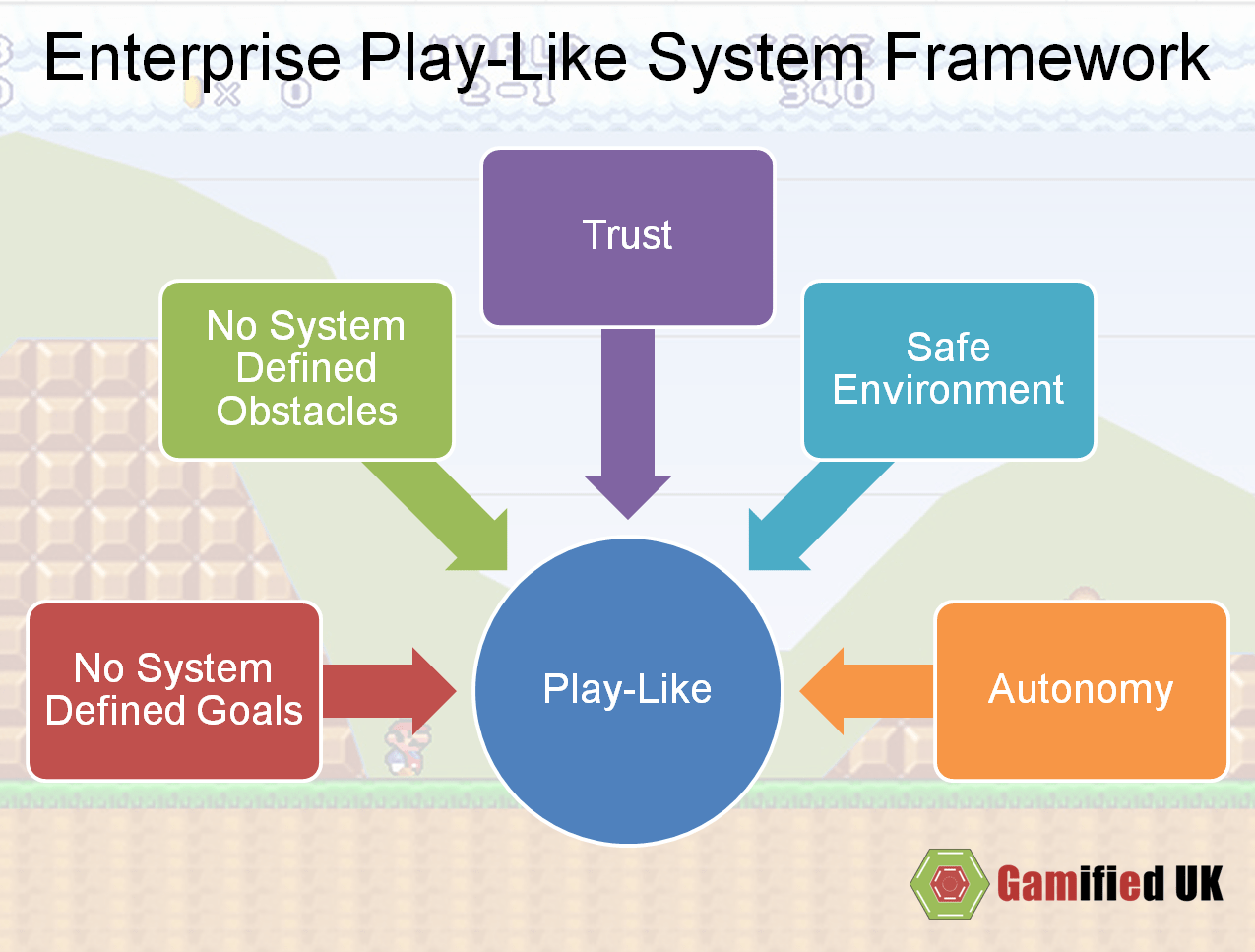
Enterprise Play Like System Framework A framework for creating play like systems

Separating Games from Play and using it

All of this research into play and talking about play has been for a reason. I wanted to try and open up the idea of making more play-like experiences rather than more game-like experiences. I was trying to introduce some of the basics that separate games and play. For this there are three important differences between play and games that we need to keep in mind.

  • Games have prelusory goals – ie, goals that you must achieve that have been set by the system.
  • Games have rules that define how you have to achieve the prelusory goals (Lusory Means).
  • They also have rules that create challenges to achieve the goals. Rather than going from A to B in a straight line, you have to overcome obstacles and solve puzzles going A to Z to E to B and back again! (Constitutive Rules)

In play, the goals are often less defined or not consciously apparent. Whilst there may be rules that dictate how play progresses (social rules, physical rules and so on), there are not that are there to deliberately challenge you or make things harder. Read More ...

Introducing Lusory Attitude

As I have been researching play, there is a term or really a word and concept that has been hard to ignore. Ludic. It comes up a lot in papers and articles about play. It comes from the Latin for play and is defined as;

Showing spontaneous and undirected playfulness.

Let me set the scene. You are in a system that follows the path outlined below.

  • You start with a tutorial. It sets the context for what you are doing as well as giving you the basic skills you need to start.
  • You are given a set of tasks to complete and goals to achieve.
  • Next you start grinding, completing the simpler tasks as you develop your skills and learn more about the system.
  • As your level of skill increases, new challenges become available and new goals are set. These may require you to learn new skills and increase your abilities.
  • Along the way there are surprises and unexpected events. You will meet new people, some will be friends and you will need to work together with them to a bribe certain goals and some won’t!
  • All the while you will be collecting experience and currency as you complete new challenges.

I’ll come back to that. Ludic turns up in various forms when academics speak about play. Here are a few examples.

  • Ludos: this is the original Latin for play
  • Ludeme: this is a concept that Raph Koster speaks about. In their simplest form a ludeme is a unit of play.
  • Prelusory goals: goals set by the game.
  • Lusory means: rules set by the game.
  • Lusory attitude: a playful mindset. An understanding that you are entering play.

The last three are from Bernard Suits definition of a game from his seminal book The Grasshopper: Games, Life and Utopia. Read More ...


Rewarding quality over quantity in gamification

Something that I see quite often is people making a simple but important mistake. They reward the behaviours that lead to quantity rather than quality.

Let me explain.

When you build a gamified campaign or activity, you need to consider what quality participation looks like. If for instance you want to create some buzz around a new product and you decide to create a simple Twitter competition, are you looking for the number of people who tweet or are you looking for the number of people whom the message will reach? Read More ...

Design compelling experiences, not addicting

A worrying trend I have noticed in gamification is people talking about making addicting experiences or applications.  You hear phrases like “Addiction loops” and “Habit forming”.

I am pretty sure that their intentions are good,  90% of the time. They are describing experiences that people will want to come back to again and again. The key word is want. If you create an experience that people want to return to, you have done your job well. If people have to come back because it is a key tool to their job, or something they have to use on a regular basis, you have done a good job if people find it usable, pain free and at time an enjoyable experience. Read More ...

Learning about playfulness from Toca Boca

Continuing my investigations into play, I wanted to talk about a few things my kids have been teaching me about just letting go and giving in to the fantasy and the lack of imaginative boundaries that real play demands. It is not as easy as it would first seem either.

There are lots of views of play out there. I offered some of my thoughts in a recent post, that play is a free form activity that is undertaken almost just because it can be and it brings fun and joy. In this sort of description, play is an activity – it follows a similar line of thought to  that proposed by Johan Huizinga in Homo Ludens. It was also Huizinga who gave us the concept of the Magic Circle – the boundary between reality and play. Read More ...

Exit mobile version