Playful design vs Game inspired design

Joy large Playful design vs Game inspired design

When I first started to describe Game Thinking, I talked about gameful design or game inspired design. Part of me was always split about what I really meant. In my mind, these ideas were based on user interface more than anything. So creating menu systems that mirrored ideas seen in games, or creating slightly more fun look and feel.

It wasn’t until I was messing around with the Snapchat interface that I realised what I was really thinking about – playful design. Design ideas that add to the pleasure of using something whilst not necessarily altering the functionality. The example that Snapchat gave me was something I discovered just by playing with the interface. If you go to your chat stream and slide up, the image at the bottom becomes an animation. At the moment it is of the Snapchat ghosts playing football. Read More ...

A small gamification victory with my daughter!

Whilst I spin through a really busy time, I wanted to share with you a minor gamification victory with my daughter.

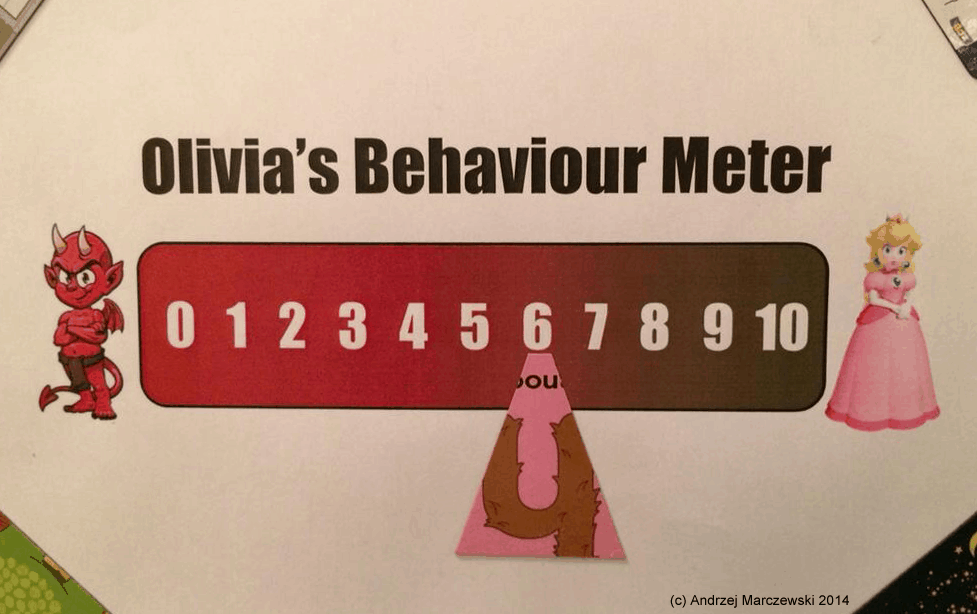
Anyone who has read my blog in the past, will know that I have been trying to use gamification around my daughters behaviour for a few years now. Not all (any) attempts have been 100% successful. The most gut wrenching failure was the use of the reward chart! However, in March, I decided to try a slightly less rewards based system – the Behaviour Meter.

This was a simple chart that displayed numbers 0 to 10, with an arrow pointing to the value that best described my daughters behaviour at the time. Whenever I felt her behaviour changed, I moved the arrow – simple! Read More ...

Flow & gamification: a misunderstanding

Flow. A popular concept in gamification, goodness knows I have spoken about it often enough – just last week in fact.  It was that article that actually made me realise that there is a distinct misunderstanding of flow as Mihály Csíkszentmihályi describes it.

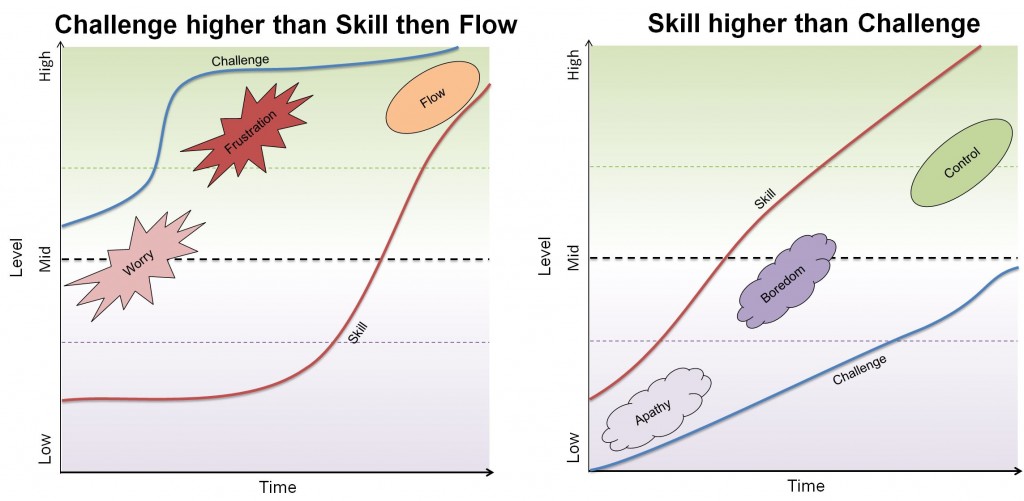
The image below is how we in gamification tend to view it, our simplified version.

We talk about the Flow Channel, the point where skill level and challenge level are in a good balance. So this would mean that Flow could be achieved when you have a balanced low skill and low chalenge. However, when we look at how Mihály Csíkszentmihályi originally described it, that would actually be apathy – not a state we want for our users! Read More ...

User Types – an expansion to consider

I have not mentioned User Types for at least a couple of blog posts – so though it was time to mess with your heads a little.

When I first started the user types, there were four intrinsic types (Socialiser, Free Spirit, Achiever, Philanthropist) which represented the four intrinsic motivators I speak about in RAMP (Relatedness, Autonomy, Master, Purpose). There was also one extrinsic type called the Player.

I later moved to eight types by expanding the player into four basic types that mirrored similar actions to the intrinsic types, but for rewards. These new types were; Networker, Exploiter, Consumer and Self Seeker. Read More ...

The Flow Shift and Bounce

This is more a thought and possibly even a question to those who know more than me about the Flow concept.  I have spoken about Flow in the past and use it as a core principle to engaging long term design.

However, recently it occurred to me that long term exposure to extremes in frustration or boredom, could alter our perception of flow.

For instance, you spend months in the boredom phase. You have little to no challenge. It seems reasonable that you would need to boost the level of challenge to help improve engagement and in turn try and get closer to this idea of flow. Below is the “ideal” mix of skill and challenge as described in flow theory – only this time plotted against time. Read More ...

Exit mobile version