



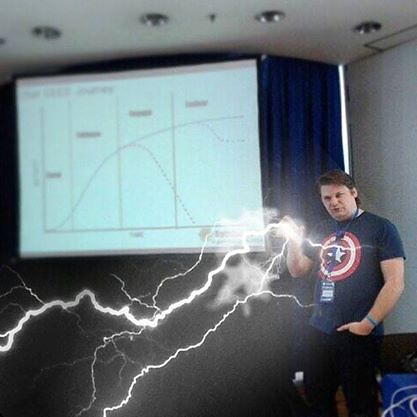
I did a very enjoyable talk at the Knowledge Cafe the other day. The audience was made up of various interested people, varying wildly in age – but with a majority belonging to Knowledge Management. It stood out for me in two ways. The first was the fact it was the first time I had done a talk with no slides. I gave the audience the option of having slides or not – they unanimously opted not (a lesson to learn here)! The second was that it was the first time I had really spoken about the concept that gamification can be viewed as lowering barriers.
Focus – it’s like a learning super power


This is a picture of my daughter playing Toca Pet Doctor. What can you see?
A child. A tablet. A game. A table. And a dress in the background?
What else?
Focus. Pure and laser like focus. My daughter is about 2 years old. I got Toca Pet Doctor for her today as a treat. My 7 year old laughed at me and said “she will not be able to play that, she doesn’t know how”.
I smiled.
After loading, the screen showed a pet. She tapped it. The screen switched to a picture of the pets fur, an open jar and 2 fleas crawling in the fur. She tapped the fur. Nothing happened. She tapped a flea, it moved. She tapped and held a flea, it stuck to her finger. She moved it to the jar, it fell in. She did the same with the second flea and waited. Both fleas jumped out of the jar. She tried again, dragging the fleas to the jar – only this time she closed the lid after she had put them in. Curtains draw and she is congratulated.
Engagement – What are we talking about?

Engagement. A word that is thrown about in gamification with all the abandon of a child dancing and singing to Frozen…
The thing is, what exactly are we talking about? What is engagement.
As ever, I took to the dictionaries to see what the word on the street is. Looking up engagement is a fruitless task as you get such gems as
A formal agreement to get married
And
The action of engaging or being engaged
However, looking up engage is a far more satisfying experience.
[with object] Occupy or attract (someone’s interest or attention)
Why User Types?

Second post in a day, not very SEO clever, I know.
I wanted to take a moment to explain my view on User and Player types and their use in gamification.
First up, some bullets so you get the idea quickly.
What User Types are not;
- Perfect
- Applicable to every situation or project
- The same in all contexts
- Pure science
What User Types are;
- A tool in an overall toolkit
- Easy to use and get your head around
- Useful if you understand their limitations
- In my case based on motivation (eg Self Determination Theory), observation and research
I created the my User Types, because I wanted to use something in my thinking and design that focused on users, but was not built for games. I had been using Bartle’s types, but they just did not fit well with gamification – this is something he repeatedly tells people! It was also very hard to talk to people in enterprise about killers (i.e. people who take pleasure in the harm they can cause others). I also wanted to approach my types from the perspective of what motivated people rather than how they behaved.
Gamification World Congress 2014

Wow, what an amazing couple of days.
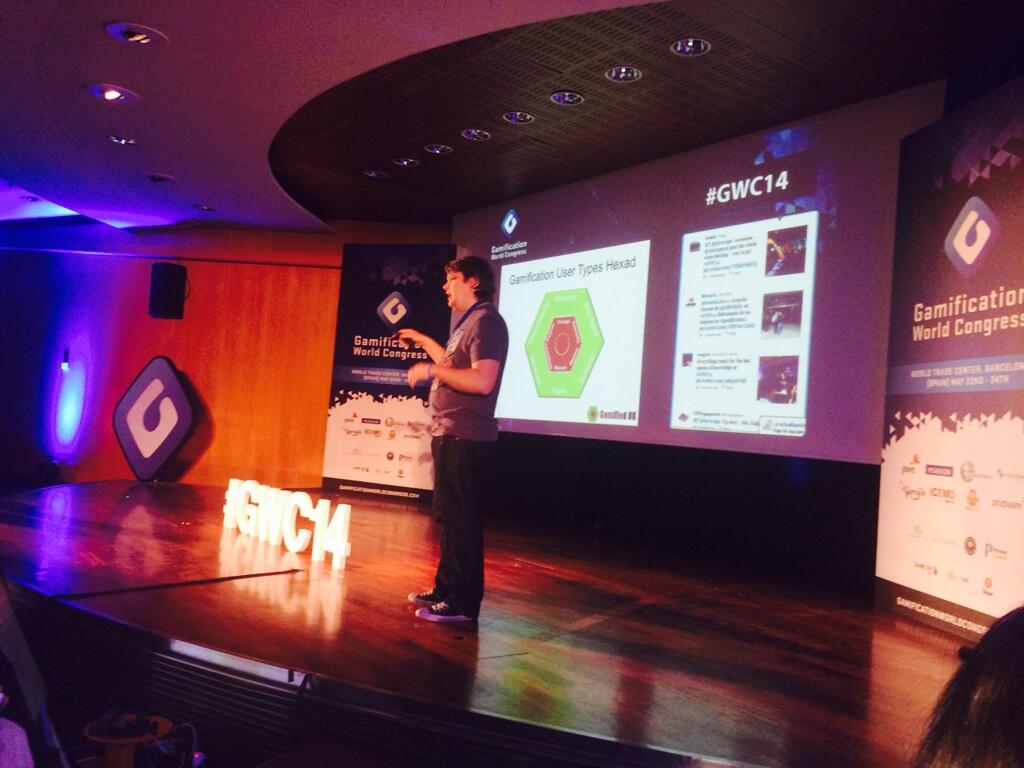
Last week was Gamification World Congress 2014, the biggest Gamification event in Europe and I think in the world with over 600 people. They all came together over 3 days to celebrate the best Gamification has to offer in 3 days packed full of talks (seriously 9 am until 8:30pm with over 30 talks on the second day!) and workshops.
On day one, 60 delegates attended 4 workshops, run by Sergio Jiménez, Mario Herger, Alberto Tornero and me.
The workshops were great fun, I think everyone enjoyed most of the content they got to see and work with. My own had some highs and lows – which I am going to build on to create my next one (details soon I hope).