Gamification: Pianists vs Computers

A thought that spawned from the back of a great Quora discussion about the role games designers in the world of gamification.

You can program a computer to play the most stunning works of classical music. You can create vast orchestras who never miss a note, or simple and flawless solo piano performances.

So why is it that people still go to see live performances, or buy cds of real people playing the music?

Heart, soul, the x-factor if you will. That something that separates each of us and makes us all individual. You can teach anyone to do pretty much anything (within physical / mental limitations of course) and they can become good at it. However, some things come from deeper than just learning. They come from a deep understanding at an almost spiritual level. Read More ...

Rewards and Reward Schedules in Gamification

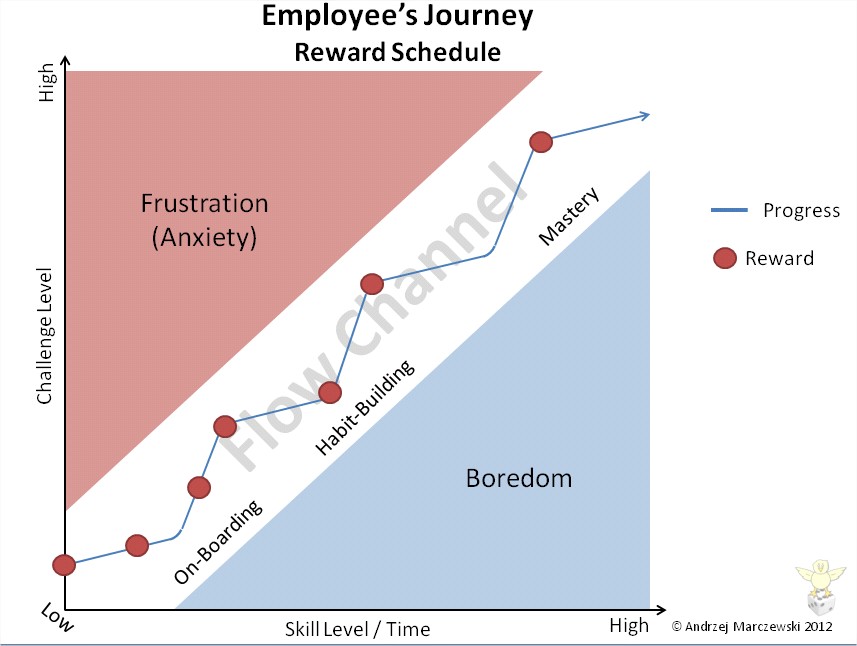
Reward schedule Rewards and Reward Schedules in Gamification

Anyone who has read a few of my blogs will, by now, be under the impression that I am not the biggest fan of rewards. Well, that is not entirely how I feel.  Those that have read earlier blogs may remember something I said – “Rewards should recognise achievement, not be the achievement”.  I also found myself saying in an email “Gamification at the moment is often nothing more than an attempt to illicit Pavlovian responses to external stimuli”. I know, how up myself does that sound – but it’s true.  The way many people are using rewards are as a way to encourage people to do things – like giving a dog a biscuit for rolling over on command Read More ...

Harry Potter and the Gamification of School

When I was a kid a school (long before Harry Potter had been thought of – and gamification for that matter…), teaching methods generally sucked. A teach stood at the front of the class, dictated out ancient notes and you had to write them down in your exercise book. If you didn’t pay attention or did something the teacher did not like, you got a board rubber thrown at your head. There was no intrinsic enjoyment to be had from the learning process; it was all drained by the way we were taught. This was not unique to my school years; it had been this way for decades. Read More ...

Driving the wrong behaviours with rewards.

I have written about this whole thing quite a lot already, but I have some new insights based on things I have witnessed recently.

We know that extrinsic rewards are meant to demotivate people when doing anything that is even slightly creative. So why do we keep seeing them being used in gamification and marketing. On the face of it, that kind of thing works well. Offer a reward and ask people to do something simple. Like this, follow that, +1 the other and you can win a book. Low and behold you can get hundreds or thousands of these clicks – great. The question is, how many of these are valuable? What is the goal? If you are trying to develop new and worthwhile interactions and relationships. Does the same person liking everything you have ever written, just to win the prize, have any actual value long term? Read More ...

The danger of extrinsic rewards on motivation – What I learned from my 5 year old

Another quick one, prompted by an interesting behaviour exhibited by my daughter today that taught me rather a lot about extrinsic rewards.

I have mentioned before the research that has been done on motivation in the past by the likes of Edward Deci and the writing of Dan Pink and more. All of them point to the same thing, extrinsic rewards are bad for intrinsic motivation. The basic reasoning is that at some point, no matter how careful you are, the reward will become the reason to do the task. The extrinsic reward replaces the original intrinsic motivation. Read More ...

Exit mobile version