Gamification is sh1t. Let’s make it better.

Gamification glossary Gamification is sh1t Let 8217 s make it better

I thought that might get your attention. Excuse the contrived use of the 1 in shit there as well, firewalls can be so jumpy about certain words.

Now back to my point.

Gamification, in far too many cases right now,  is indeed shit. I am not saying gamification itself is bad, just a lot of the uses and applications of gamification that we are seeing out there falls into that particularly odorous category.

It’s as if gamification has become the duct tape of user design. “The user experience is a bit off, what should we do? Add gamification”. “The system is not great, people get stuck and don’t like using it, what should we do? Add gamification – points and badges will fix it!”. “We need to improve efficiency in the department. How can we do that? A leaderboard you say? Let’s do it!” Read More ...

Gamification: The users perspective

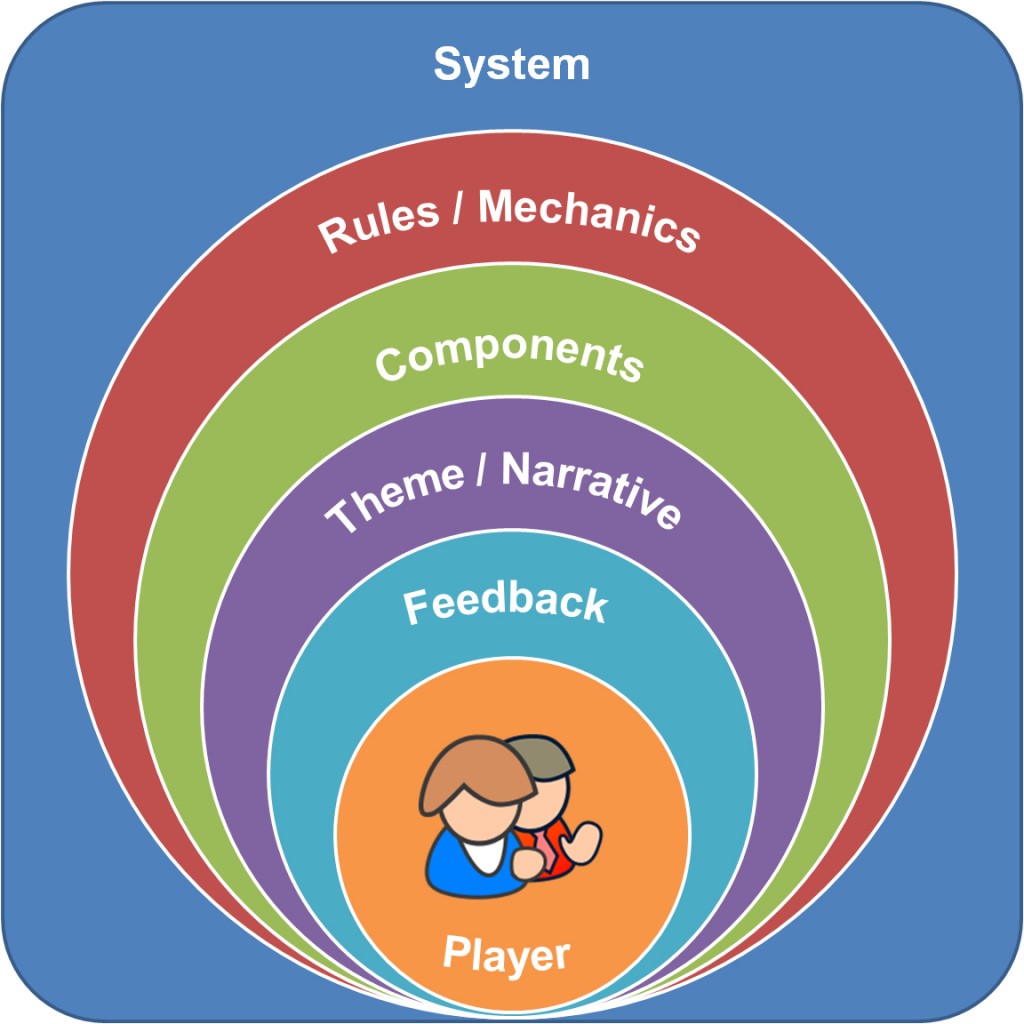
As a gamification designer, it is easy to get hooked up on the intricacies of the system. The feedback mechanics, the game mechanics, the economy and the cleverness of it all. It is also easy to think, “this is going to be great” when you have a new idea and then spend waaay to long making the idea real.

What we need to to is step back from time to time and say “How will this actually impact the user”.

For example. You have this fabulous animation that you want to make use of. It fits the overall theme of the gamified solution you are building and think that it adds a little bit of playfulness to break up part of the process. Great. However, what does it really give the end user? If it is used once and adds some greater value to the process they are going through, by giving a new understanding or insight – then brilliant. If it really does give the user a break for a particularity complex part of the process, then okay. If it sits there and forces them to watch it, possibly more than once with no option to skip – step away from the idea. Read More ...

Playful design vs Game inspired design

When I first started to describe Game Thinking, I talked about gameful design or game inspired design. Part of me was always split about what I really meant. In my mind, these ideas were based on user interface more than anything. So creating menu systems that mirrored ideas seen in games, or creating slightly more fun look and feel.

It wasn’t until I was messing around with the Snapchat interface that I realised what I was really thinking about – playful design. Design ideas that add to the pleasure of using something whilst not necessarily altering the functionality. The example that Snapchat gave me was something I discovered just by playing with the interface. If you go to your chat stream and slide up, the image at the bottom becomes an animation. At the moment it is of the Snapchat ghosts playing football. Read More ...

A small gamification victory with my daughter!

Whilst I spin through a really busy time, I wanted to share with you a minor gamification victory with my daughter.

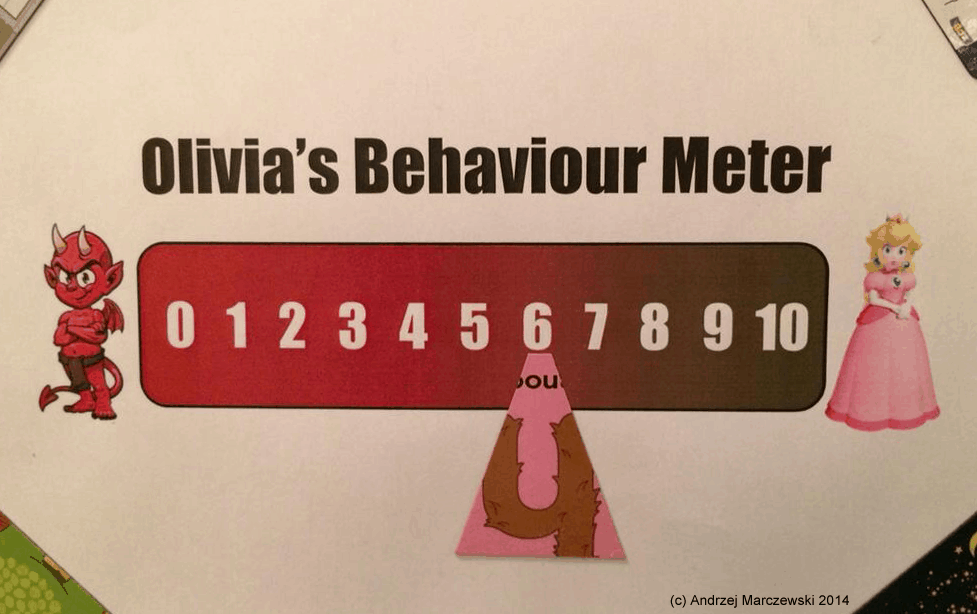
Anyone who has read my blog in the past, will know that I have been trying to use gamification around my daughters behaviour for a few years now. Not all (any) attempts have been 100% successful. The most gut wrenching failure was the use of the reward chart! However, in March, I decided to try a slightly less rewards based system – the Behaviour Meter.

This was a simple chart that displayed numbers 0 to 10, with an arrow pointing to the value that best described my daughters behaviour at the time. Whenever I felt her behaviour changed, I moved the arrow – simple! Read More ...

Flow & gamification: a misunderstanding

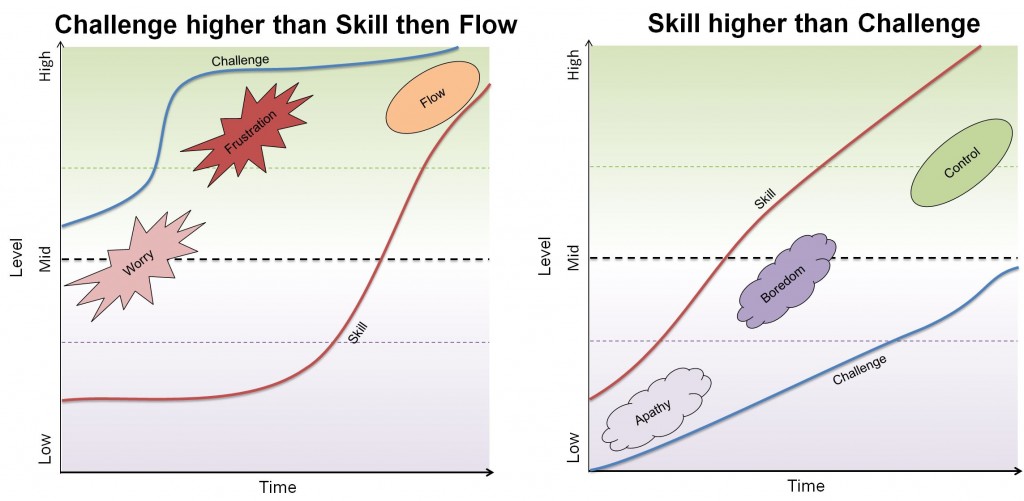
Flow. A popular concept in gamification, goodness knows I have spoken about it often enough – just last week in fact.  It was that article that actually made me realise that there is a distinct misunderstanding of flow as Mihály Csíkszentmihályi describes it.

The image below is how we in gamification tend to view it, our simplified version.

We talk about the Flow Channel, the point where skill level and challenge level are in a good balance. So this would mean that Flow could be achieved when you have a balanced low skill and low chalenge. However, when we look at how Mihály Csíkszentmihályi originally described it, that would actually be apathy – not a state we want for our users! Read More ...

Exit mobile version