



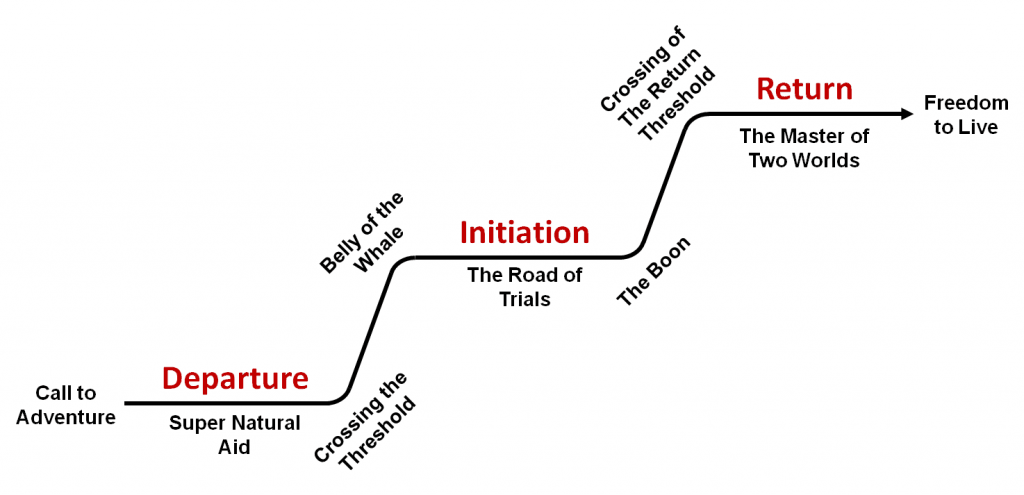
What follows is a little bit of fun, but one that may help you take another look at how you are planning your user journey in gamified systems. In storytelling and therefore in games there is a structure that is well known and well used called the Hero’s Journey or Monomyth. It was first described by Joseph Campbell in 1949 to show how many myths all followed a very similar structure. In the modern world, it can be seen in stories such as Star Wars and The Lord of the Rings. It can be seen in video games as well, one example being the Zelda games.

Points and Badges in Gamification – Not totally evil.

Over the last few days, the conversation about the use of points and badges has come up several times with several different people.
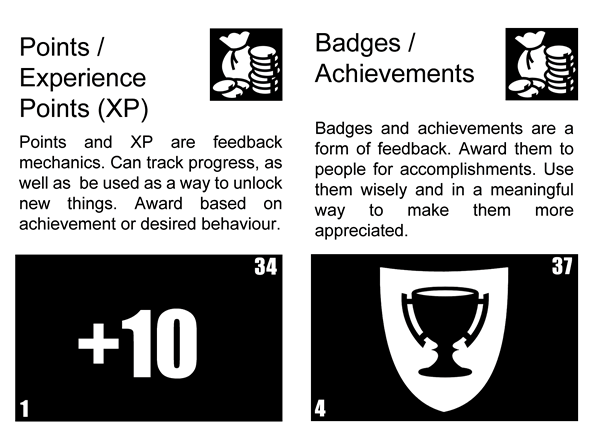
The stock answer in gamification these days is that points and badges are bad gamification. They are meaningless and we should be looking at intrinsic motivation more – yet almost every implementation you see of gamification will have some form of points system and probably badges. They may be called experience points and achievements, or gami-dollars and pictograms – who knows – but they still seem to be there.
Activity Loops in Gamification


Many moons ago, I wrote a piece on Feedback Loops a system used in games to help balance or unbalance a system. Whilst I was designing the boards for my gamification inspiration cards I started playing around with the idea of activity loops. These are essentially the same idea as feedback loops, but rather than balancing or unbalancing a system, they are used to encourage a user along a desired path of activity. They do not make it easier or harder to achieve my goal, they encourage the user to achieve a goal.
Gamify your drive home


One of the day to day activities that I gamify in my life, is driving. More specifically, driving economically. Best of all, you don’t need to have some expensive gamified car (like the leaf) or any apps.
My car, like most now, has an on-board computer. I have this set to always show me my current miles per gallon (MPG). The game that I play with myself revolves around keeping the MPG number as high as possible. I do this by basically driving sensibly. Not having the air-con on all the time, being in the right gear etc. It is a very simple bit of gamification that revolves around two basic mechanics. Feedback and reward.
Gamification Inspiration Cards


Introduction | About the cards | Want to buy a deck? | More ways to play
Introduction
I don’t know what it is, but I love cards. I think it stems from my parents, who were avid Bridge players. We always had several decks Bridge cards lying around. I like how they feel in your hand, how they smell, how they sound as you shuffle them. When I first discovered that people had been producing sets of cards for everything from project management to game design and of course gamification, I was a happy man! I own several of these kinds of decks now and love them all.