Collection of gamification thoughts from the last few weeks

What is gamification Collection of gamification thoughts from the last few weeks

Hi all.

Not a real blog as such today, just a collection of things I have been doing and saying for the past week or so!

A Video

First off, the video of my Gamification of a Career talk at Gamification World Congress has now gone up on YouTube 🙂

A Picture

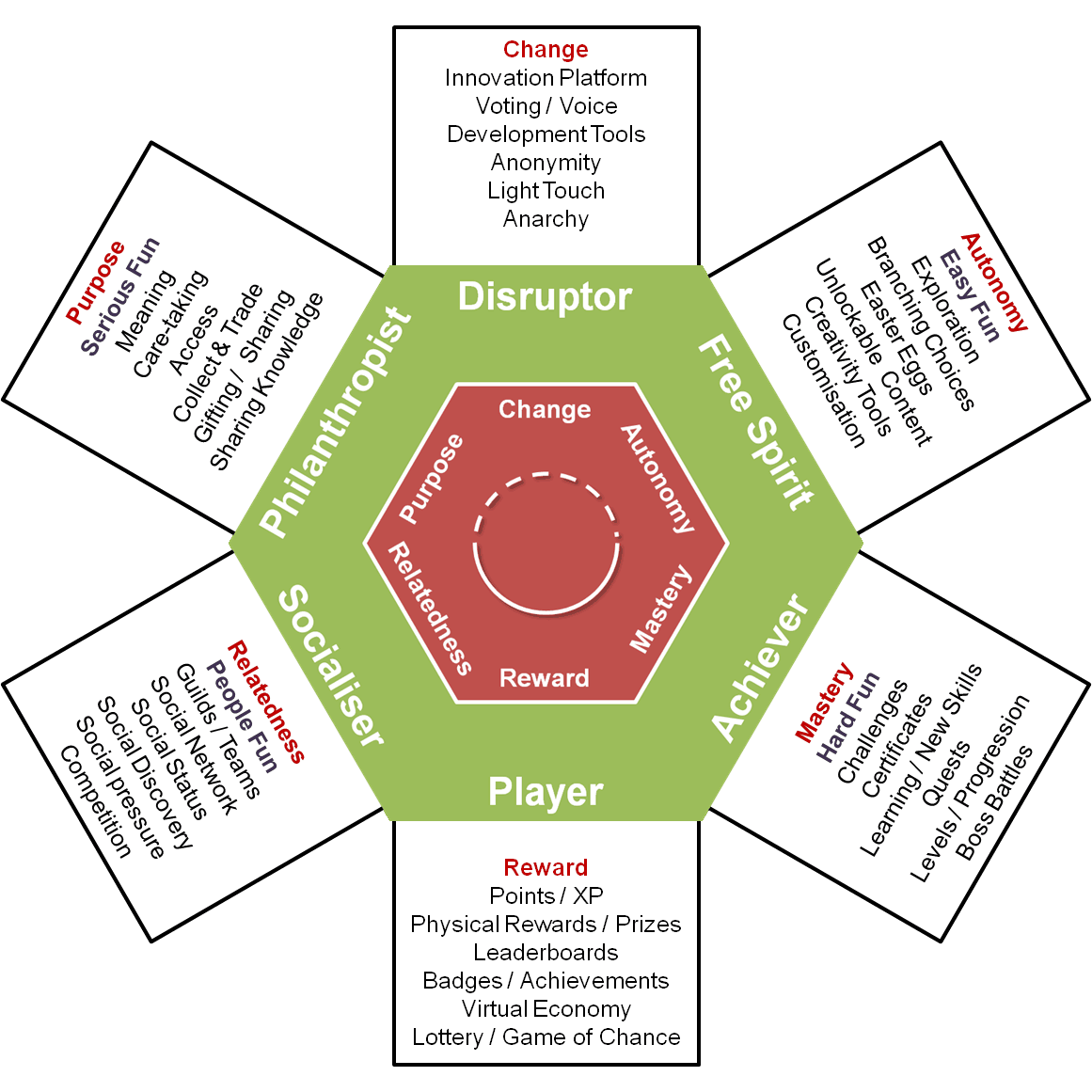
I was asked on twitter how my User Types might fit with education, this picture was my first run at an answer.

Some Words

Here is a collection of some of the things I have been saying on twitter – may be of interest to some!!

  1. Gamification is not a technology. It is an approach to solving problems.
  2. Gamification can only be the answer if you fully understand the question.
  3. Use gamification to thank people for doing things, not to bribe them into doing them.
  4. If your system is broken, gamification won’t fix it. Chances are it will make it worse! Gamify to solve a specific problem.
  5. Remember. People play games because THEY want to. People use your gamified system because YOU want them to.
  6. Reward systems in gamification are not inherently bad – just badly implemented. Meaningful pats on the back can help early on in a program.
  7. Gamification can be used to motivate, it can also be used to manipulate – which do you think will lead to long term engagement?
  8. Good gamification is not about tricking people into using a system; it is about building a system people are happy to use.
  9. Gamification is not about understanding games, in the same way as driving is not about knowing braking distances.
  10. A lot of gamification is still like a monkey dressed as a ninja. It may look the part, but you wouldn’t rely on it in a fight!

An Infographic

Finally, an infographic I made that talks you through my gamification framework using lots of other ideas from my blog! Read More ...

Gamification: Quests, Objectives, Goals and more

One of the great things about games is how they handle objectives. Very rarely will you play a game these days that sets out one huge objective and just leaves you to it, they all break the main objective into sub-objectives.  You tend to have an overall story line or a quest. This is then broken down into levels, missions or sub-quests, these are then further broken down into objectives, goals or tasks.

One of the main reasons for this, is that it is much easier for us to manage short term goals than long term goals. This can be attributed to things like how we process data, how our memories work, how we handle decisions etc. The further away a decision is, the more abstract it is to us (according to Construal Level Theory), the closer it is the more concrete.  What this means to us here is that long term goals or objectives are hard for us to focus on properly, they seem to abstract, unreal.  Short term goals are closer to the now and so feel more real and more importantly attainable. Read More ...

Gamification User Types 2.0

I mentioned that I was trying to simplify and improve my gamification user types. Version 2 is just that and a little more. After more research and the results of mine and others surveys on the matter, I have realised a few things. The four basic types; Achiever, Socialiser, Philanthropist and Free Spirit are all fine. They work and can be left exactly as they are.  I am also happy that the extrinsic types (Consumer, Networker, Self Seeker and Exploiter) are ok, however – they have caused a lot of confusion with people. I made everything a little too black and white – it was as if people saw my intrinsic types and extrinsic types as good and evil! Read More ...

Designing a simple “Thin Layer” gamified system.

I thought this week, after 2 years of avoiding it, I would write a short starter for actually creating a gamified system.  This will cover the basics of what I call a Thin Layer system – also known as PBL (Points, Badges and Leaderboards) system.

Now, before you all shout at me for explaining how to do a system that I can often be heard saying is not the best type of gamification, consider this. Thin Layer is the most common type of system out there and it is the easiest to start with. It can also be very effective over short periods of time, for things like short campaigns, education and on boarding into deeper systems. The point is (as Kris Duggan from Badgeville once pointed out to me), sometimes, something is better than nothing, as long as it is well designed and created for a purpose. My view is, of you are going to try – you should at least be armed with the right information to make the best go of it possible. Read More ...

User Types Test: Stats and conclusions

Since I first launched my User Types nearly a year ago, I have had lots of great feedback, interesting criticism and a few changes of heart here and there. I have tried to evolve the types and add detail to them, in an attempt to help other people make use of them. The goal was to create a usable framework to help you plan and build gamified systems by identifying a few basic types of users and how to engage them.

Along the way, I seem to have actually made it too complex for many – something than 1.5 tries do deal with (a little). It is also based in part on the stats I have collected from the User Types test that has been running for many months now. So first, some stats. Read More ...

Exit mobile version