Gamification to encourage my daughter to read more

Reading Journey Gamification to encourage my daughter to read more

As any regular reader will know, I spend a lot of time gamifying my daughter, in a good way. She has taught me a great deal about what does and doesn’t work in the real world.

Most recently I was trying to encourage her to read more, so decided to test out my EEEE framework with her. She was doing it, but it was a real battle, she found it frustrating and not very enjoyable.

My Daughter, based on observation of how she plays games and acts, is part Free Spirit, part Achiever and part Player. That is to say, she likes to have freedom to choose, explore and be creative. She loves when she understands a new concept and nails it, but she does like to see some kind of reward if it is available. Read More ...

How to Use Game Thinking

A while back I started to introduce my alternative catch-all to Gamification, that is Game Thinking.

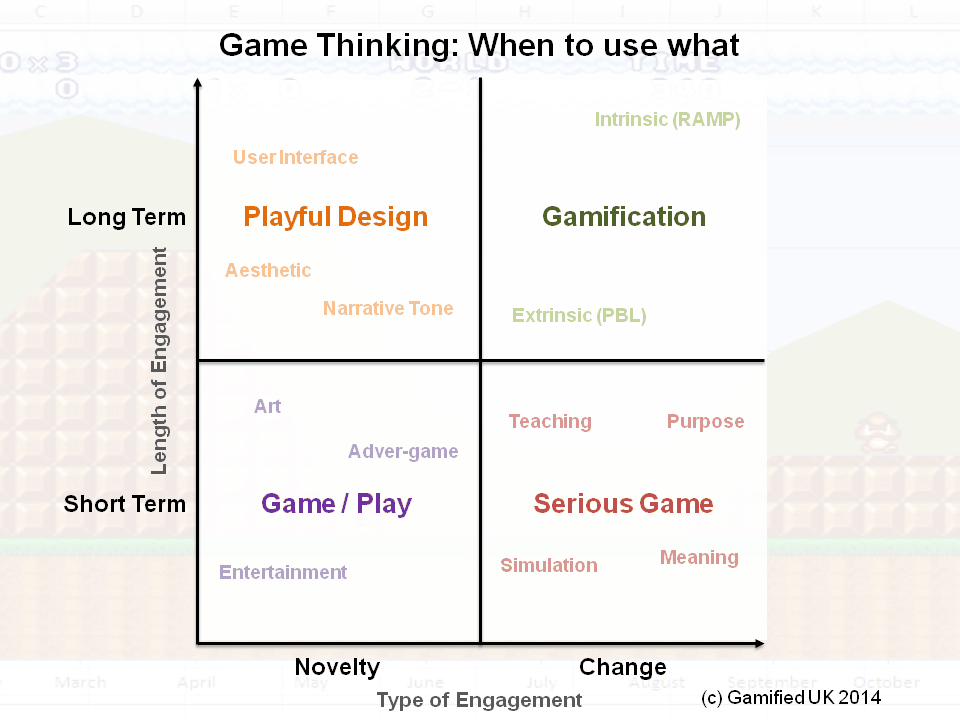
Game Thinking takes four common components of game like or games based solutions and puts them under a single banner. Those are Playful Design / Game inspired design, Serious Games, Games and Gamification / Motivational Design (more on that another day). I was asked recently under what circumstances each would be most appropriate, so I hit powerpoint and made the following matrix thingy!

This is very similar to the Thin Layer vs Deep Level gamification model I presented a while ago – though slightly contradictory on the length of gamification engagement, so forgive that one! Read More ...

Critisism – well a rant really.

This is a rant – you will find no insight here.. Move along…

I’ve written about criticism in the past, but wanted to bring it up again just for fun.

A couple of days ago, I received some criticism. Nothing to major, but for some reason it really set me off!

I Am pretty good with criticism, I grew up with it. From being labelled as stupid by a school that could not be bothered to offer help for dyslexics, to being called lazy by a medical practice that did not wish to diagnose M.E. as it did not exist, I deal with it pretty well. Read More ...

Gamification: Novelty is not enough

Recently the following video has been doing the rounds.

It shows a great idea to get people to stop at crossings when the red light shows. The idea is that rather than a boring red man stood there you get a real time animation of someone dancing in a booth a little further away.

They claim that the number of people stopping rose to 81%, which is awesome.

It also hooks into loads of motivations. You have free spirits are engaged as they get to dance their hearts out. Philanthropist types will like that by dancing they are helping reduce accidents. Achievers will want to do the best dance possible, whilst players will want to beat all the other dancers. Socialisers get to watch the show and chat to the people around them also watching. Even disruptors have a chance to be subversive in their actions in the booth! Read More ...

My 3 main focuses for rewards and feedback

One of the key things that I consider when looking at anything in gamification is how feedback is going to be handled. For me, feedback is anything that gives a user some understanding of progress and achievement. This can be something as simple as a message that says “You have completed the survey”, to a full virtual economy working with points, badges, levels, leaderboards, trading, prizes etc! They are all just there to keep the user informed.

I feel there are three important aspects that need to be considered when designing feedback and rewards for any system though. It should be – cue another mnemonic – RIM…..! Read More ...

Exit mobile version