New Podcast – The Andrzej & Roman Show

A and r New Podcast 8211 The Andrzej 038 Roman Show

Before I get on to giving you all Part 2of the managing expectations blog, I wanted to officially say that Roman Rackwitz and I have a new podcast coming soon!

We will be taking a look at the state gamification, talking about topics close to us in the gamification world and how gamification might relate to current events in the world. With luck, it will be fun, light-hearted and insightful!

We will start recording soon, but if you want to get set up now to receive notifications of when the first episode is ready, you can head to Spotify now! Read More ...

Gamification Challenge: Can You Defeat Bigotry?

As I walked through town recently, I was reminded rather forcefully that homophobia and bigotry still exist in a big way.

As my family and I were walking through a charity store, a man was loudly saying the following to his 3 or 4-year-old son.

Don’t tell me you kissed a boy. Stop kissing boys, it ain’t natural!

I am a parent to two girls, both of whom are open about the fact they don’t label themselves in any specific way when it comes to their preferences towards gender. Hearing this made them both upset and mad as hell – as it did me.

So here is my challenge to you all. How would you use gamification to try and solve this kind of bigotry, to get through to this kind of Neanderthal that it is not ok to be like that?

My way involves behaviour modification and counting lost teeth, which is just as unacceptable in this day and age!

You and I have all the theory in the world by now and have applied much of it – but in reality, this is the sort of issue we should be trying to turn our skill to in our own time. Is the answer to creating training programmes that we have to somehow encourage them to take? Is it more about changing the way the government treats this sort of behaviour? Is it a social change that will take decades, but needs the likes of us to guide and design? I think we all know the answer, but I refuse to believe that we can’t make any impact on this problem, that there is no way with all our knowledge on behaviour that we can’t somehow make a difference.

Or is that where gamification becomes a lie? Is it just about making more money for others? Has my faith over the last 10 years or so been totally misplaced?

Prove me wrong, prove that gamification is more than a way to make people take mandatory training, buy more products or click more links. Prove to me that my children don’t have to live in a world like this and that we can make a real difference.

Who’s with me?

The Engagement Channel Model 2.0: Fun, Flow and Engagement

Fun. A three letter word you won’t hear me mention often when discussing gamification! Why? Well, fun is really subjective. What you find fun, I may not. However, for the purposes of this blog, we will assume I like fun as do you and when I mention fun – it means something you will find fun!

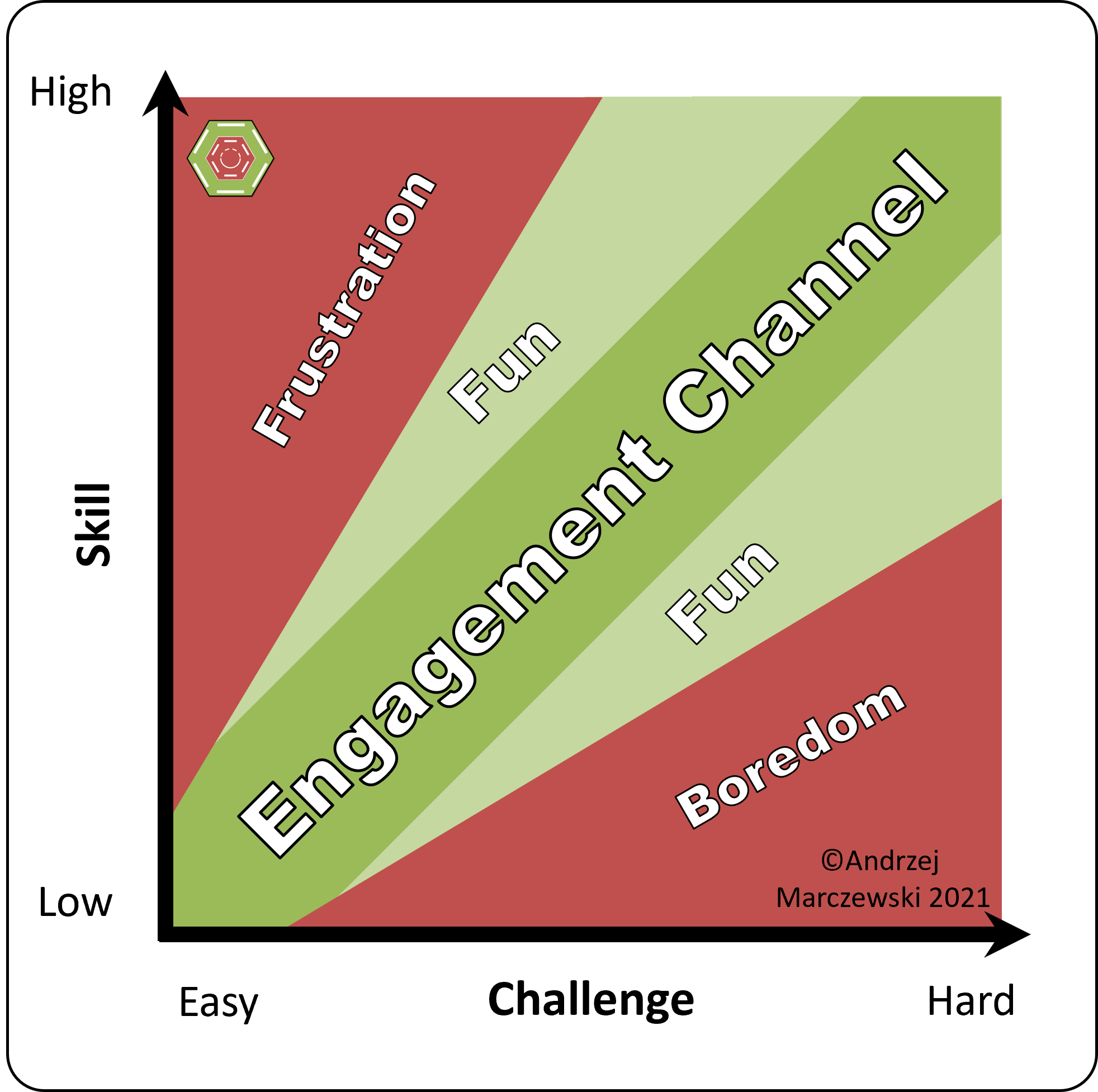
With that out of the way, here’s the thing. If you look at Flow or my Engagement Channel stuff, you will see that to enter flow and be truly engaged, the challenge of whatever you are doing should match or slightly exceed your current skill level.

As with my Engagement Channel model, you can soften the impact of a challenge being too much by adding meaningful rewards and you can soften the impact of your skills being greater than the challenge, by adding personal challenges.

However, in games I am seeing more and more games that drop you straight into a scenario where the challenge instantly far outweighs your skills. By all our models, this should lead to instant frustration and most likely disengagement – but it doesn’t always. For some reason, there are some games that I play, that no matter how tough they are and how far off my skills are from the challenge – I keep coming back over and over again. Why? Because they are fun to play!

Does this mean there is another dimension to the Engagement Channel or the our view on Flow?

BJ Fogg

If we look at BJ Fogg’s famous Behaviour Change Model, we can see that there are three main dimensions in his B=MAP formula. Behaviour = Motivation x Ability x Prompts.

Basically for a behaviour to happen, motivation, ability and prompts all need to align. If a task is hard, but you have high motivation to do it – the right prompt will start to encourage the behaviour. If the task is easy, your motivation can be lower with the correct prompt. A third factor can influence the outcome without anything else changing.

So, how can I steal this idea and start to add a new dimension to my Engagement Channel Model. Well, I’m glad you didn’t ask!

The Engagement Channel Model 2.0

To simplify the original concept, what I am now proposing is that fun can act as a buffer between engagement, frustration and boredom, essentially widening the Engagement Channel.

Now, I am not trying to tell you what your users may find fun, what I am saying is the older I get, the more I realise that fun makes a huge difference to your motivation to do things, even if they are really hard or if they are slightly boring. Adding that element of fun can make all the difference.


New Solution & Gamification Design Lenses Card Deck

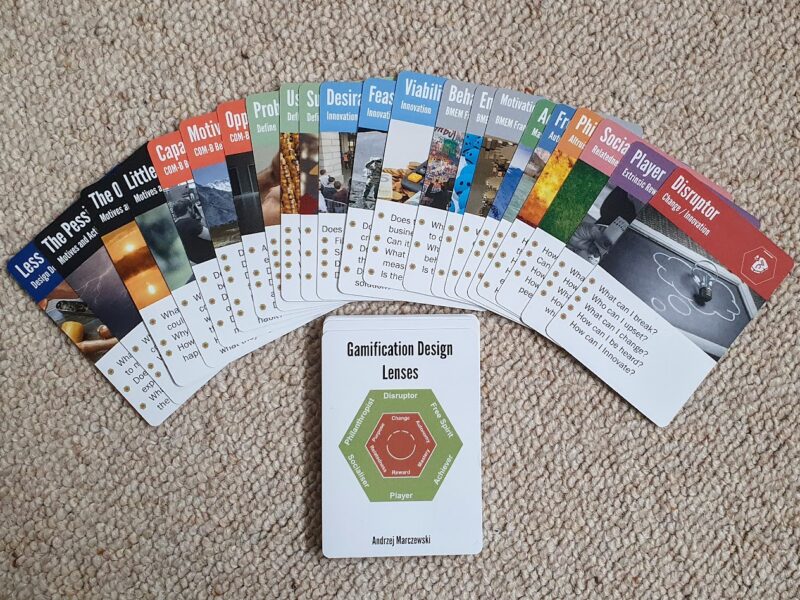
For the first time in a while, I have a sort of new product for you! The Solution & Gamification Design Lenses Card Deck!

Basically it is a series of cards that contain questions related to various frameworks I use in my life as a solution designer. They cover ground from the User Type HEXAD, to the COM-B behaviour change model and lots in between – including the “What’s the worst that could happen” card!

Available through DriveThruCards, they come as a deck of 44 cards – which is actually 2 decks of the 22 cards, just to try and make them better value for you. I am also providing a downloadable deck for you if you want that instead.

Buy Them!

The link to the physical cards is https://www.drivethrucards.com/product/362861/Gamification-Design-Lenses

You can get the download and print deck from here [purchase_link id=”8718″ style=”plain” color=”” text=”£10 Download Buy Now!” direct=”true”]


The Danger of Unbalanced Incentives and Negative Expectations

I recently saw a news article that certain parts of America were trialling an incentive program to try and encourage more people to get the COVID-19 vaccine. The idea was that individuals could earn $100 by getting vaccinated.

If you have ever read any of my work, you will probably know that I am not a big fan of large incentives to do things that should be done for intrinsic reasons. To me staying safe and keeping people safe is reason enough to take the vaccine – but hey – we are not all the same.

Very quickly I started to see people on Twitter complaining. Not that this was a bad idea, but that they wished they had not taken the vaccine already and could be eligible to get the free money!

In isolation that may not seem an issue, however, it does have a potential knock as effect should anything like this ever happen again as a negative expectation has been set. Rather than people taking the vaccine early, they will wait until the Government gets desperate and starts to incentivise people to take it – after all, that is what happened the last time.

I accept that this probably seemed like a good idea at the time, I mean, when do politicians ever think about unintended consequences!?

How could this be prevented then?

Well, I’m glad you asked! If you think you will need to incentivise behaviour, do it at the start and reward positive and early action higher than late. This sets the expectation that being early is better than being late. For instance, a parking ticket encourages you to pay quickly or the fine doubles!

In our vaccination example, set the initial incentive as $100 if you get it in the first round and drop it to $50 if you are late.

However, even better than that, educate people more effectively. Provide simple, truthful and unsensationlaised information that explains the benefits and potential risks whilst shutting down conspiracies and silliness as early as possible.

In gamification, we know all of this. You only incentivise when you absolutely have to and you make sure that the most positive and constructive actions are highly rewarded compared to other behaviours and actions.

Exit mobile version