The RAMP to Fun

RAMP to Fun The RAMP to Fun

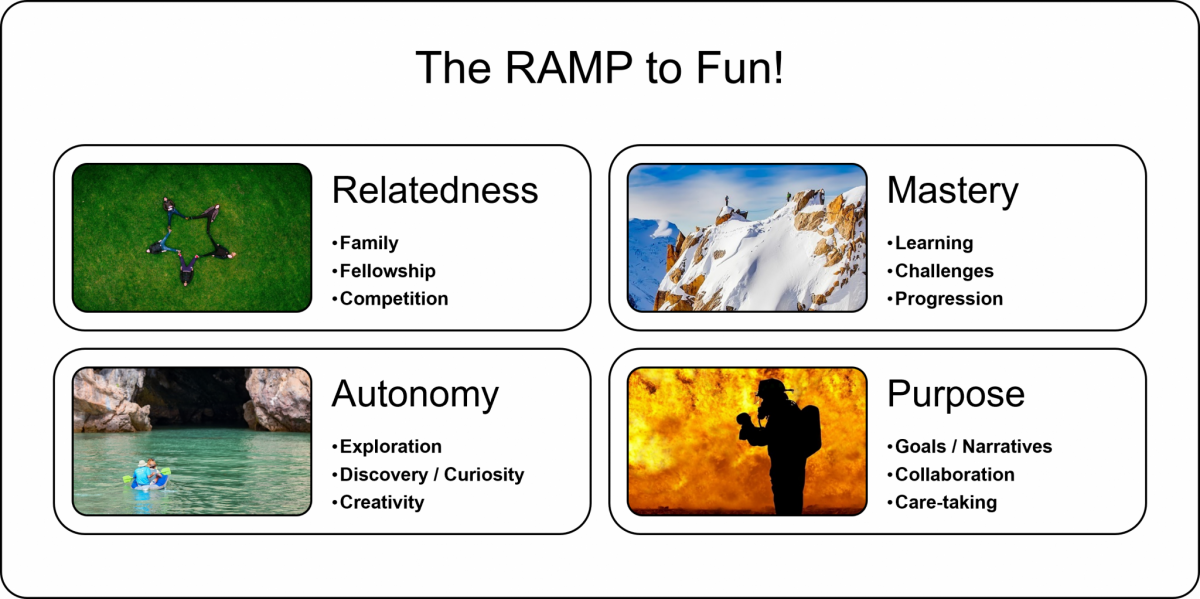
A while back I started talking about FUN again. In that post I mentioned the RAMP to Fun, but never actually posted it! So here it is in full PowerPoint diagram glory 😀

This is obviously based on my RAMP, but also on some research I did a long time ago on what people find fun.

The idea is that you need to include elements, mechanics and concepts that people will find fun – even if these do not look fun to you on the surface. As they all hook into core intrinsic motivators – some will find them fun! The more you can link together and embed – in a way that is sympathetic and sensible to the design, the better. Read More ...

What’s Your Biggest Gamification Challenge? (And Episode 3 of the podcast is out)

I wanted to ask you guys what you feel your biggest challenge in gamification is? For me, it is getting folks to take gamification as an industry seriously. There are many reasons for this, a lot of which we dive into in the latest Andrzej & Roman Show (Yeah shameless plug)!

Whatever the reason for this may be, it is imperative that you overcome it quickly. I’ve told this story many times, but it is worth repeating. I once sat in a meeting where less than 5 minutes into the presentation, the client just stopped me and said “I hate everything you have said so far. We don’t play games, we are too busy” Read More ...

Learning from Games: Managing Expectations – Part 2

Continuing on from Part 1, as is the tradition, where we looked at how they manage your expectations right up to learning how to play, now we are now going to look at how games manage expectations during gameplay. If you have not read Part 1 – head there now! Learning from Games: Managing Expectations – Part 1

Difficulty – Setting the Skill Expectations

Many games, before or during play, allow you to change the difficulty settings. I remember Doom doing this particularly well, using rather grim terminology to set the scene for what to expect! Where Doom chose negative language, making you feel like you are probably going to get destroyed in moments – Duke Nuk’em went for slightly more bravado filled options. “I’m too young to die” became “Piece of Cake” for instance! Read More ...

The Engagement Channel Model 2.0: Fun, Flow and Engagement

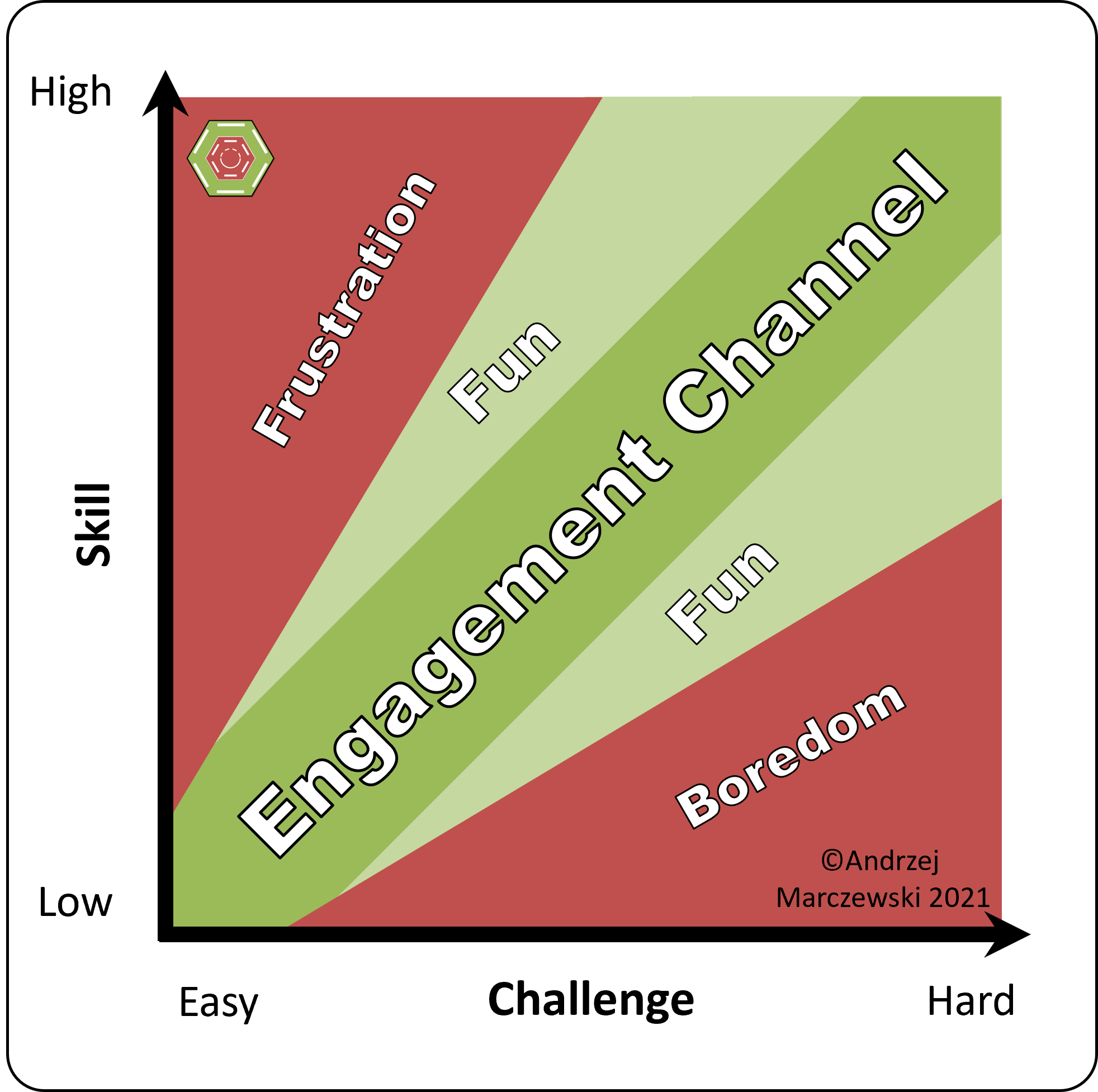
Fun. A three letter word you won’t hear me mention often when discussing gamification! Why? Well, fun is really subjective. What you find fun, I may not. However, for the purposes of this blog, we will assume I like fun as do you and when I mention fun – it means something you will find fun!

With that out of the way, here’s the thing. If you look at Flow or my Engagement Channel stuff, you will see that to enter flow and be truly engaged, the challenge of whatever you are doing should match or slightly exceed your current skill level.

As with my Engagement Channel model, you can soften the impact of a challenge being too much by adding meaningful rewards and you can soften the impact of your skills being greater than the challenge, by adding personal challenges.

However, in games I am seeing more and more games that drop you straight into a scenario where the challenge instantly far outweighs your skills. By all our models, this should lead to instant frustration and most likely disengagement – but it doesn’t always. For some reason, there are some games that I play, that no matter how tough they are and how far off my skills are from the challenge – I keep coming back over and over again. Why? Because they are fun to play!

Does this mean there is another dimension to the Engagement Channel or the our view on Flow?

BJ Fogg

If we look at BJ Fogg’s famous Behaviour Change Model, we can see that there are three main dimensions in his B=MAP formula. Behaviour = Motivation x Ability x Prompts.

Basically for a behaviour to happen, motivation, ability and prompts all need to align. If a task is hard, but you have high motivation to do it – the right prompt will start to encourage the behaviour. If the task is easy, your motivation can be lower with the correct prompt. A third factor can influence the outcome without anything else changing.

So, how can I steal this idea and start to add a new dimension to my Engagement Channel Model. Well, I’m glad you didn’t ask!

The Engagement Channel Model 2.0

To simplify the original concept, what I am now proposing is that fun can act as a buffer between engagement, frustration and boredom, essentially widening the Engagement Channel.

Now, I am not trying to tell you what your users may find fun, what I am saying is the older I get, the more I realise that fun makes a huge difference to your motivation to do things, even if they are really hard or if they are slightly boring. Adding that element of fun can make all the difference.

The Engagement Channel Model

In gamification, you will hear a lot about Flow. I myself have spoken about it many times. In games and gamification, we use it as a way to describe the moment that you get the challenge of a task exactly balanced with the skill of the person involved, leading to a state of absolute focus and possibly flow.

I have also written about how we in gamification especially get our description and understanding of Flow very wrong. But that is another story!

Anyway, I have been rethinking this a lot and have decided to stop talking as much about flow and more about the Engagement Channel.

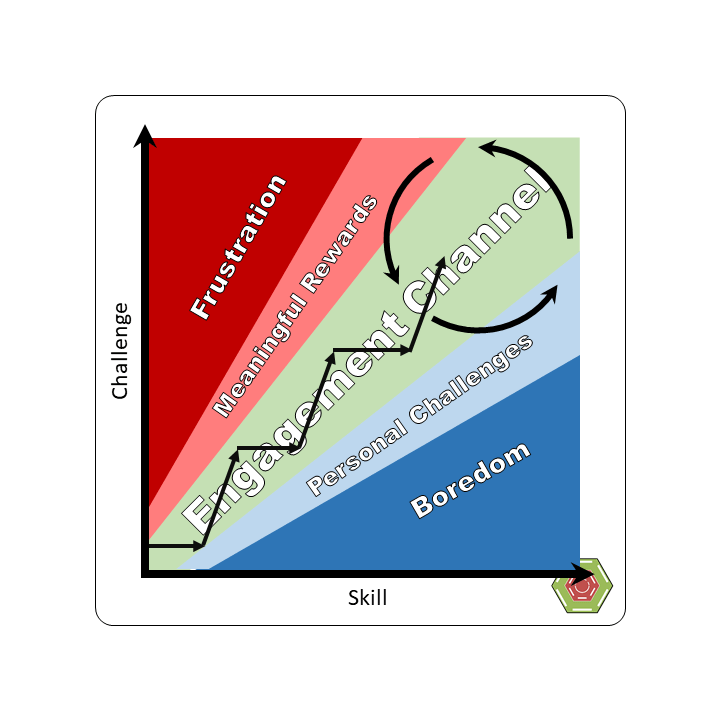
Yes, the image is almost identical to the Flow image that I have used in the past. It focuses on the idea that if you can get the challenge and skill balanced just right – people will be more engaged and get the best experience. If the challenge is too much for them, they get frustrated, too little they get bored.

Rewards and Challenges

Over lockdown, I have started to play video games more than I have in a few years. One that has been especially enjoyable is Star Wars: Battlefront 2. It’s a simple enough shooter, but it has made me think a bit about how I understand the balance of challenge and skill in a game.

I have been mostly playing Co-Op mode. This sees you and 3 other players taking on various waves of enemy soldiers in an attempt to capture the map.

By our usual description of how challenge and skill need to balance, you would expect the challenge to increase constantly as you play the game. But the reality is, it doesn’t seem to change much. My skill constantly increases, but the waves of bad guys stay the same, the objectives stay the same – but yet I still enjoy every game as much as the last.

But why? Should I not be getting bored? My skill has increased, but the system created challenge is the same.   It took me a while to work it out, but I think I have it. Whilst the system designed challenges – the levels, the bad guys the objectives – don’t change, my character and my personal challenges do.  New weapons, skills and upgrades are unlocked allowing me to do more and achieve new heights.

The game doesn’t change, I do. I get new skills, creating my own personal challenges to overcome. Initially, I wanted to upskill my sniper but soon realised I enjoyed playing as the heavy weapon specialist, so began to challenge myself to unlock all the weapons available, to get all the news skills and to get all of the various trophies and awards related to killstreaks and the like. The game allowed me to do this, encouraged it even, providing rewards for my efforts and keeping me interested in achieving more.

So, my concept of the Skill vs Challenge model has had to change. New dynamics have entered into my mental model.  Personal Challenges and Meaningful Rewards. To prevent boredom as system challenges remain the same, provide opportunities for the emergence of personal challenges to keep players engaged. On the flip side, to prevent frustration, provide meaningful rewards to give players hope and a reason to be resilient and continue playing, even if their skills are not quite up to it, encouraging them with congratulations, empowering them with new tools.

So, I present my new Engagement Channel Model! Let me know your thoughts 😊


Exit mobile version