Relationships Between HEXAD Types

Type relationships Relationships Between HEXAD Types

It’s been a while since I wrote about the HEXAD user types, but the world does not stand still and I keep seeing them turning up in academic papers – which is amazing, so I thought it time to say a few words on things that have repeatedly come up!

I was inspired by a recent paper by Ana Cláudia Guimarães Santos, Wilk Oliveiraa, Juho Hamari and Seiji Isotani called “Do people’s user types change over time? An exploratory study ” You can grab a copy here.

Without spoiling too much, they come to many conclusions about the types, but one that stuck out for me was Read More ...

Confirmation Bias and How to Embrace Being Wrong – #UX

When we design anything, be it user experiences, gamified experiences or even just Lego buildings – we become emotionally involved with what we are doing. We invest ourselves in the process and the outcomes of the process.

Because of this, it can be very hard for us to accept someone telling us that they think we may be wrong. When they tell us you should really have used a 4 block not a 6 block on that side of the wall to make it stronger, but we have already finished the wall – the last thing we want to accept is that they may be right and taking apart the wall would lead to a better end model! So we engage our Confirmation Bias to help us justify continuing on what may well be the wrong path. Read More ...

6 rules for surviving and enjoying social media.

1. Don’t believe everything you see or read.

Social media has no filter, so anyone can post almost anything and they don’t always post the truth. From politicians to socialites, very often what is put out is tweaked in some ways be it the facts or the flawless texture of a models skin. Be alert to it.   

2. Do your research.

This goes hand in hand with the first rule. Sadly you can take everything at face value. It takes very little time to fact check, but use reliable news sources and websites, not gossip rags or other social media sources.

3. Don’t over share.

If you wouldn’t tell your gran don’t tell social media publically. Public social media sites like twitter, Tik Tok or Instagram are great places to share what’s on your mind, your latest talents and so on. It’s fun and can be very rewarding. However, some things just don’t need to be shared to the world, doing so can come back and bite you in the future. Many celebrities have fallen foul of drunken tweeting one day and losing their job the next!   

4. Do use the report features.

The report features on social media are their for a reason. If you see things that are inappropriate, harmful, hurtful etc, report them. It is anonymous and there to protect everyone.

5. Don’t obsess.

It can be all to easy to get hooked on social media. That’s how all the apps are designed, they want your attention for as long as possible as that’s how they make money. If you find yourself unable to sleep because you are worried you might miss something, or are anxious because you only got 1 like, it may be time to take a break or even seek some advice and help.   

6. Do have fun.

Social media is meant to be fun, so use it in a way you enjoy. It may be just reading the latest happenings in your fandom, it may be sharing your singing or photography skills etc. You can make good friends through sensible use of social media and have a great time.   Be sensible, be safe, be alert and when it stops being fun, take a break.

Why “undo” is critical to ludic design

Ludic, or playful design, involves designing products or experiences through the lens of play. How do you make people feel safe to explore, encourage experimentation and even add some fun?

A while back I introduced my Play Framework, so you can find out more there, but essentially it’s all about creating an environment that focuses on Trust, Safety, Autonomy, Dynamic Goals and Lusory Attitude (that is you approach the experience with a playful attitude).

So where does the undo function in a bit of software like Word come into this, how is that helping with ludic design? Feelin safe is all about not fearing failure. If something goes wrong, you need to feel that it is possible to recover. If you fall over, you should know you can get up and try again – see where this is going?

The undo feature does exactly this. If you make a mistake in Word, just undo it. Got the function wrong in Excel? Undo it. Messed up your image in Photoshop? Undo, undo, undo, undo!!!

Being able to undo your last action, or actions means that you get to feel safe to explore and to experiment as much as you like. Not being scared of making mistakes can really help to get the creative juices!

So when you are designing a solution, see how you can include a way to take back the last actions a user has made, make them feel safe and secure that failure is not a bad thing!

The Engagement Channel Model

In gamification, you will hear a lot about Flow. I myself have spoken about it many times. In games and gamification, we use it as a way to describe the moment that you get the challenge of a task exactly balanced with the skill of the person involved, leading to a state of absolute focus and possibly flow.

I have also written about how we in gamification especially get our description and understanding of Flow very wrong. But that is another story!

Anyway, I have been rethinking this a lot and have decided to stop talking as much about flow and more about the Engagement Channel.

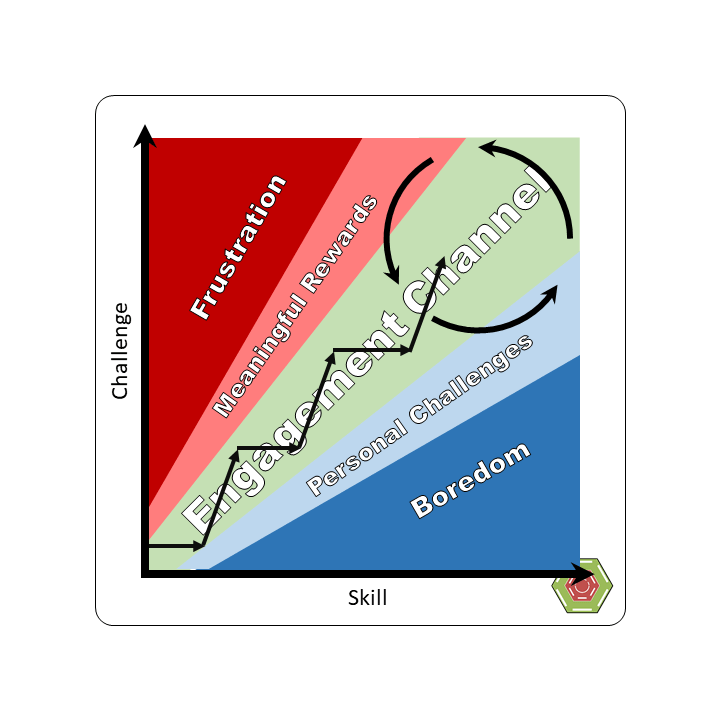
Yes, the image is almost identical to the Flow image that I have used in the past. It focuses on the idea that if you can get the challenge and skill balanced just right – people will be more engaged and get the best experience. If the challenge is too much for them, they get frustrated, too little they get bored.

Rewards and Challenges

Over lockdown, I have started to play video games more than I have in a few years. One that has been especially enjoyable is Star Wars: Battlefront 2. It’s a simple enough shooter, but it has made me think a bit about how I understand the balance of challenge and skill in a game.

I have been mostly playing Co-Op mode. This sees you and 3 other players taking on various waves of enemy soldiers in an attempt to capture the map.

By our usual description of how challenge and skill need to balance, you would expect the challenge to increase constantly as you play the game. But the reality is, it doesn’t seem to change much. My skill constantly increases, but the waves of bad guys stay the same, the objectives stay the same – but yet I still enjoy every game as much as the last.

But why? Should I not be getting bored? My skill has increased, but the system created challenge is the same.   It took me a while to work it out, but I think I have it. Whilst the system designed challenges – the levels, the bad guys the objectives – don’t change, my character and my personal challenges do.  New weapons, skills and upgrades are unlocked allowing me to do more and achieve new heights.

The game doesn’t change, I do. I get new skills, creating my own personal challenges to overcome. Initially, I wanted to upskill my sniper but soon realised I enjoyed playing as the heavy weapon specialist, so began to challenge myself to unlock all the weapons available, to get all the news skills and to get all of the various trophies and awards related to killstreaks and the like. The game allowed me to do this, encouraged it even, providing rewards for my efforts and keeping me interested in achieving more.

So, my concept of the Skill vs Challenge model has had to change. New dynamics have entered into my mental model.  Personal Challenges and Meaningful Rewards. To prevent boredom as system challenges remain the same, provide opportunities for the emergence of personal challenges to keep players engaged. On the flip side, to prevent frustration, provide meaningful rewards to give players hope and a reason to be resilient and continue playing, even if their skills are not quite up to it, encouraging them with congratulations, empowering them with new tools.

So, I present my new Engagement Channel Model! Let me know your thoughts 😊


Exit mobile version