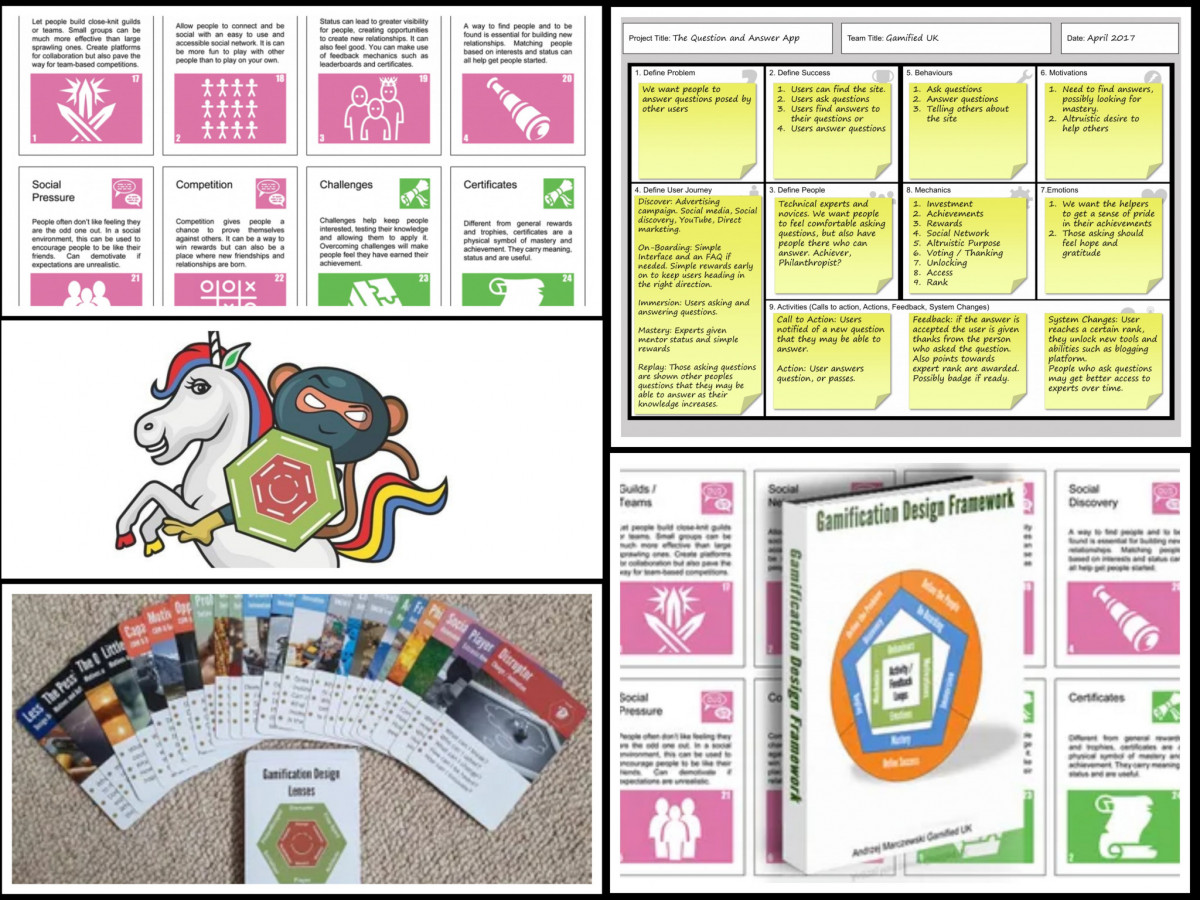
The Gamified UK Value Pack for ONLY £9.99

Collage The Gamified UK Value Pack for ONLY 9 99

Act Fast and Get Over £50 Worth of Gamification Content and Tools for ONLY £9.99! Become a Gamification Pro with the Ninja Monkeys Unicorn Edition eBook and Other Premium Content Included in This Bundle. Don’t Miss Out on This Incredible Offer – Start Building Your Gamified Solutions Toda

This bundle includes all of my premium content.  Even Ninja Monkeys Unicorn Edition eBook (which contains some content, not in the normal retail versions), Gamification and Solution Design Lenses, Inspiration Cards and my Gamification Framework Design Toolkit Read More ...

Gamification and the F word….

Bit less Gamification and the F word 8230

So, in my last post I set the cat amongst the pigeons a little by offering my new definition of gamification. Well, the conversations that followed were superb 🙂 That’s one of the reasons I did it, to start up the conversation again – to get people to step away from the business as usual rut gamification is now in and start think about what it actually is to us and to the client!

So here is another comment that goes against a lot of what I have said and heard in the past.

Fun.

It’s a word I have avoided when discussing gamification for the same reason many do – fun is subjective.

via GIPHY

What you find fun, I might not. There are many frameworks for fun and I will talk about my RAMP to FUN in the next blog, but I think we should be looking more and more at how we can make experiences fun. My flip side of that is to at least make it less shit!

So a new definition for you 😉

Gamification (noun) The process of making something a bit less shit and a bit more fun!

And hey – you can even buy the t-shirt https://www.etsy.com/uk/listing/1110223994/gamification-a-simple-definition?ref=listing_published_alert 

I was wrong: A definition of gamification that should make sense to everyone!

Gamification 2022 taller I was wrong A definition of gamification that should make sense to everyone

I was wrong… for many years in fact. So, here I am again, banging on about definitions. I have been here before, but usually trying to push through the idea of a more academic and “correct” definition of gamification. However, over the years I have realised that this is not much use to most people! I have banged my head against more tables and brick walls that I would care to mention trying to get people to understand “no, it’s not about games…. Well it could be… urm…”

This comes down to the fact that in the non-academic world, the word gamification, or gamify sits in a series of words that essentially mean to become more of something, or to become it!

Take the word beautify as an example. The Oxford dictionary defines that simply as  “make beautiful”. Whilst we are thinking of the word simply, it also defines simplify as “make simple”.

So, it stands to reason that the layperson would look at the word gamify and assume it means “make gameful” or just “make game-like” (as gameful isn’t really in common language still). And, as we are looking at this from the layperson perspective – I’m throwing in the word game as well, not just game-like!

If we go on to define the noun version of beautify,  beautification, we would use something like  “the process of making something more beautiful”. We don’t see anyone defining it as “the process of using elements of beauty in non-beauty contexts”!

In the same way, the definition of gamification should be “the process of making something a game or more game-like”.

And this is where the issue lies for most people, especially those outside of the academic world. The definition of a word is pretty direct and simple, it does what it says. It doesn’t contain caveats or descriptions of what is not included, it is just what the word is, means or does.

You can add the how and the why, but that might change in different contexts. For instance, we could talk about the beautification of urban areas.

Beautification of urban areas: the process of making urban areas more beautiful to improve the aesthetic qualities for those who live there by adding parks and green land.

In the same way, you could say

Gamification of learning materials: the process of making learning materials into a game or  more game-like to improve users experience, participation and completion rates by using the materials in a scenario-based simulations, with deep gameplay as well as progress markers such as points and badges”

The point of all of this nonsense is that my big takeaway after 10 years of trying to explain gamification is that most people just assume the word is defined the same way other words that end in “ify” and “ification” are, not caveated and twisted to exclude the main item they think it refers to! They don’t care that strictly speaking it should not include full games and points and badges are too simple to be part of it and…  blah blah blah.

So from now on, accepting that I have spent 10 years probably hammering home something considered wrong to the majority of non-experts in the world, I am using the following…

“Gamify (verb): make a game or game-like”

“Gamification (noun): the process of making something a game or game-like”

I use “something” here rather than ” an experience, service, system, UI, turnip etc” because I am trying to keep it as simple as clients want it to be. We can add context and methods after they understand this.

What game-like may contain could be up for discussion, but as far as most clients are concerned, it absolutely covers everything from adding points and a leaderboard all the way up to making a full game – so it should mean that to us as practitioners if we ever want to get over the massive speed bump which is still the word Gamification!

Don’t get me wrong, from an academic perspective and from a practitioner to practitioner perspective there are still 50 shades of gamification and game based solution design to talk about. However, we are in the business of solving problems, not creating them because we feel that serious games and gamification are different and should not be spoken about in the same breath, or that we should correct the prospective client for their lack of understanding!


The Engagement Channel Model 2.0: Fun, Flow and Engagement

Engagement Channel Model 2 0 The Engagement Channel Model 2 0 Fun Flow and Engagement

Fun. A three letter word you won’t hear me mention often when discussing gamification! Why? Well, fun is really subjective. What you find fun, I may not. However, for the purposes of this blog, we will assume I like fun as do you and when I mention fun – it means something you will find fun!

With that out of the way, here’s the thing. If you look at Flow or my Engagement Channel stuff, you will see that to enter flow and be truly engaged, the challenge of whatever you are doing should match or slightly exceed your current skill level.

As with my Engagement Channel model, you can soften the impact of a challenge being too much by adding meaningful rewards and you can soften the impact of your skills being greater than the challenge, by adding personal challenges.

However, in games I am seeing more and more games that drop you straight into a scenario where the challenge instantly far outweighs your skills. By all our models, this should lead to instant frustration and most likely disengagement – but it doesn’t always. For some reason, there are some games that I play, that no matter how tough they are and how far off my skills are from the challenge – I keep coming back over and over again. Why? Because they are fun to play!

Does this mean there is another dimension to the Engagement Channel or the our view on Flow?

BJ Fogg

If we look at BJ Fogg’s famous Behaviour Change Model, we can see that there are three main dimensions in his B=MAP formula. Behaviour = Motivation x Ability x Prompts.

Basically for a behaviour to happen, motivation, ability and prompts all need to align. If a task is hard, but you have high motivation to do it – the right prompt will start to encourage the behaviour. If the task is easy, your motivation can be lower with the correct prompt. A third factor can influence the outcome without anything else changing.

So, how can I steal this idea and start to add a new dimension to my Engagement Channel Model. Well, I’m glad you didn’t ask!

The Engagement Channel Model 2.0

To simplify the original concept, what I am now proposing is that fun can act as a buffer between engagement, frustration and boredom, essentially widening the Engagement Channel.

Now, I am not trying to tell you what your users may find fun, what I am saying is the older I get, the more I realise that fun makes a huge difference to your motivation to do things, even if they are really hard or if they are slightly boring. Adding that element of fun can make all the difference.

The Truth About Gamification: The Ugly, the Bad and the Good

Gamification The Truth About Gamification The Ugly the Bad and the Good

Gamification is a little over 10 years old now, but has much really changed since its wild days of infancy?

I remember when I first started getting involved in 2011, it was a time of excitement, learning and playing. There were meetups, webinars, conferences, knowledge sharing and all sorts going in. It was liberal, free and fun!

But, as with all these things, over time that changed. Empires were built and lost, big corporates started to take ownership of ideas, the sharing and excitement gave way to to proprietary information and closely guarded secrets.

Some tried to continue to carry the torch, and still do, but many fell to the side – either  jumping to the next exciting technology in the hype cycle, or moving on to other interests naturally.

But, in 2021, what is the real truth of gamification now? Well, let’s see if I can’t get some discussion going by offering a few of my truths!

The Ugly

The worst thing about gamification in 2021, is that people still don’t understand what it actually is. With many experts (holding my hands up here) disagreeing amongst themselves what it should be – so of course the wider public have no idea!

Hot on the heals of that, is the number of people still selling “quick win” solutions and “magic bullets” off the back of the word gamification. Promising to solve any and all problems a client may have with a simple plugin offering points and badges. This dovetails with the lack of understanding people still have, as it makes them easy targets which many are happy to take advantage of. “Oh isn’t it shiny and it’s a bit like a game, so people will love it!” “Follow the shiny shiny”

The Bad

Even amongst those that do get gamification, there is still an awful lot of bad proactive and overpromising being done. The amount of time I see statistics used to demonstrate “400% increases in engagement” with no information on how many people that might include is astonishing. More often than not, when you scratch the surface you discover that what that really meant was when they had no users engaged, they now had 4 engaged!

Another issue is that there is still so little hard evidence of what works and what doesn’t work. We all still work off case studies from 2013 with very few new public case studies getting quoted in presentations. I watch presentations now that are using the same information, same data, same key messages that we were using back in 2011 from up and coming experts in the field. What’s worse is, there is plenty of data if you are willing to look for it.

Which brings us to

The Good

Whilst there may not be much data on what does and doesn’t work from a mechanics and implementation perspective, there is plenty of data that proves gamification and serious games work in everything from employee engagement to healthcare and beyond. Just spend 5 minutes on Research Gate and you will find hundreds of great research papers saying just that. Validated tools, frameworks, research projects, methodologies, case studies and more are all there for the finding.

Gamification is being used for great purposes. My proudest moment in recent years was seeing some of my work being used in a paper titled “Gamification Design Elements to Enhance Adolescent Motivation in Diagnosing Depression”. Seeing my work being used to help with such serious topics, rather than just to make companies more money, made me smile for days!

Gamification is still here, this is good, it means that it is still in with a chance of maturing, with the pretenders and gold rushers dropping off and the real experts still slogging away. It is likely to evolve and to morph, probably into an arm of User Experience Design, but it is still here.

This may seem like a bit of a downer, but it is anything but that! This is my mental reset button, laying waste to the crap that is out there whilst laying foundations of hope for the future, like a Room 101 for gamification.

So with that in mind – what would you throw in my Room 101 of Gamification and what would you want to promote to those up and coming into our world?