Different Types of Users in Gamification

User types1 Different Types of Users in Gamification

There is rather an important update at the end after Richard Bartle offered me some advice!

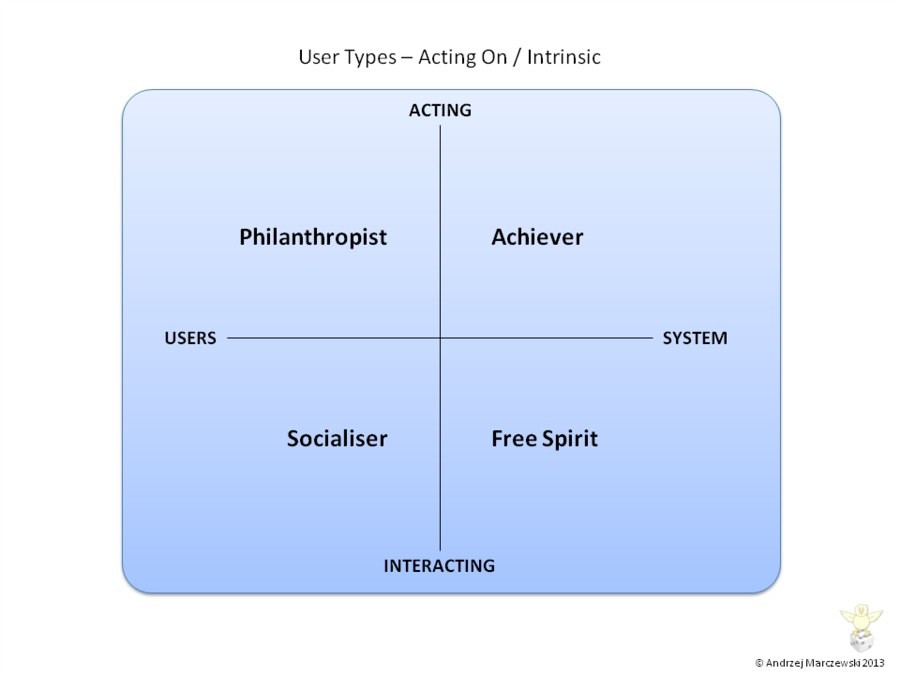
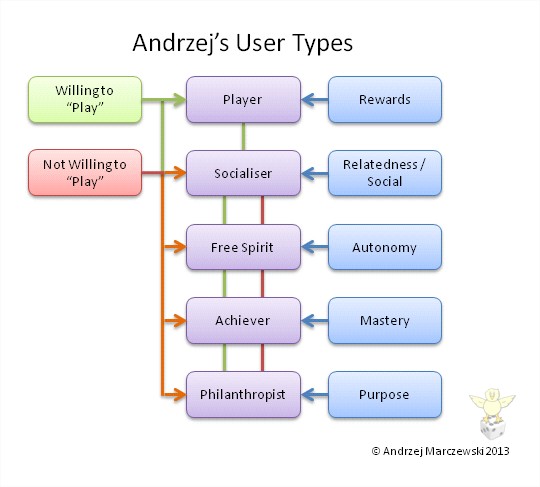
It had to happen eventually. I had to look at some kind of “player type” theory.  Many people have one, Richard Bartle probably having the most famous and most abused of the player type theories out there.

What’s it all about Richard?

For those that don’t know, Richard Bartle labelled players as one of four types to help him understand how they interacted with each other and their environments in MMO games (Massively Multiplayer Online). The labels he used initially were; Read More ...

Gamification a Little on Leaderboards

Leaderboarded Gamification a Little on Leaderboards

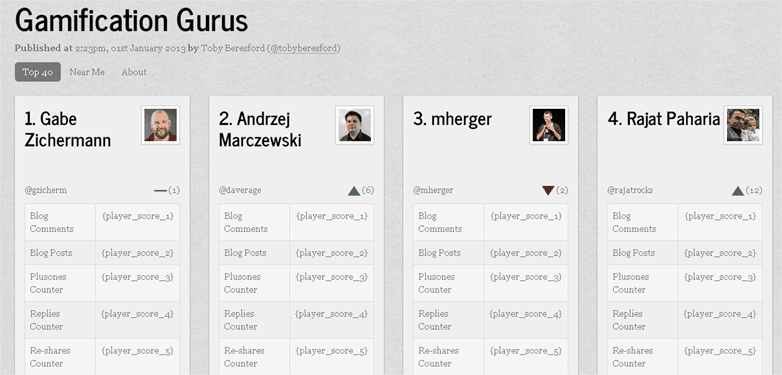
Leaderboards are an effective way to show a user quickly where they currently stand within a gamified system. A fun example is the Gamification Gurus leaderboard from the company Leaderboarded. Each month they release an update that shows  who has been active in the gamification world that month.  It is a great example of a leaderboard being used in isolation – without all of the points and badges that are often associated with simple gamification.

Many blogs and websites these days make use of a comment system called Disqus to manage their comments.  It has a few plug-ins that you can easily add to your site if you are using it for comments. One is a Top Commenter’s box. If you look at my blog, you should see it in the side bar. It shows people, at a glance, who is posting the most comments on your pages. Read More ...

Game Mechanics in Gamification

Gamified like motivators and supporters Game Mechanics in Gamification

This is a long post for me, so get a cup of tea now!

One of the main things that I have found whilst research and writing about Gamification, is that the terms and the language we use don’t always seem to fit what were actually doing. As gamification matures, so to should the language that we use to discuss it. One term that seems to get particularly abused, which we have borrowed from game design, is Game Mechanics. This all came from various discussions I had been having with people in the games industry.  All of them told me that they felt that most people in gamification are getting this (and more) wrong. Read More ...

Feedback and Drivers in Gamification

Feedback and drivers Feedback and Drivers in Gamification

I spoke about rewards and reward schedules a couple of weeks ago, now I want to look at feedback.  If I am honest, this will repeat ideas I have mentioned before, but is should give a little more meat and context.

Feedback comes in many forms, not all of them as obvious as we may think. It is also vital to any gamified system that feedback exists. It helps user keep track of how they are progressing, how they are “doing” within the system.  One of the complaints about the “real” world is that feedback is often very slow. End of year reviews, report cards, midterm exams.  In the game world, we are used to constant and instant feedback.  Collect something and you are notified immediate.  Complete a level and you are told, gain experience and you are notified.  All of this happens straight away, no waiting around months and months to understand how you have done.  In call of duty, you don’t have to wait until the end of the month to find out how you have performed in the last 20 matches.  You are told constantly during the match and they you are given a summary of achievements at the end. Read More ...

Gamification: Pianists vs Computers

1394979 30116283 Gamification Pianists vs Computers

A thought that spawned from the back of a great Quora discussion about the role games designers in the world of gamification.

You can program a computer to play the most stunning works of classical music. You can create vast orchestras who never miss a note, or simple and flawless solo piano performances.

So why is it that people still go to see live performances, or buy cds of real people playing the music?

Heart, soul, the x-factor if you will. That something that separates each of us and makes us all individual. You can teach anyone to do pretty much anything (within physical / mental limitations of course) and they can become good at it. However, some things come from deeper than just learning. They come from a deep understanding at an almost spiritual level. Read More ...