Introduction to Gamification Part 10: Narrative

Intro to Gamification Part 10 Introduction to Gamification Part 10 Narrative

Narrative is in my opinion, one of the most powerful yet underrated ways of improving almost anything! A good story can carry you through the most boring of times by creating the most exciting of images in your imagination.

However, building stories into certain, less “play” compatible environments can be a challenge. So can creating stories that fit with the very “stop/start” nature of many gamified environments.

What is Narrative?

First, let’s look at what narrative actually is. Put over simply, a narrative is just a story. However, the way I like to look at the difference between a narrative and a story is that a narrative is happening now, whereas a story has already just happened (and a collection of stories is a history…). Read More ...

Getting Sh*t Done with A Little Gamification

Gamified Tasks Getting Sh t Done with A Little Gamification

I was recently chatting to a guy who was complaining that his task list was so long that he couldn’t even work out where to start from. He had all the tasks in Excel but just couldn’t figure out what to do first. Nothing had due dates, just he knew they all needed doing “at some point”.

We had a long chat and I gave him a simple algorithm to help get started.

Algorithm 1.0

  • First, prioritise each task with a scale of 1 to 5, 1 being vital and 5 being “whenever”
  • Next, give each task a difficulty rating of 1 to 5, 1 being easy and 5 being mega tough.
  • Finally, sort by priority then by difficulty.

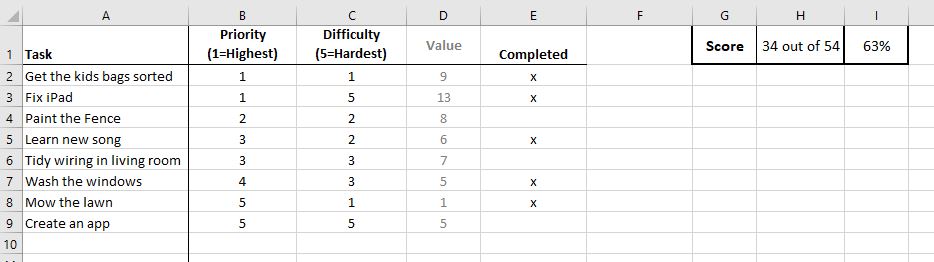
You will end up with a list a bit like this

TaskPriority
(1=Highest)
Difficulty
(5=Hardest)
Get the kids bags sorted11
Fix iPad15
Paint the Fence22
Learn new song32
Tidy wiring in living room33
Wash the windows43
Mow the lawn51
Create an app55

Then, what you are looking for is a “quick win”. Look for the task that has the highest priority with the lowest difficulty, in this case, “Get the kids bags sorted”. This is an easy job that is very important and will get you started. The first step of any journey is always the most difficult and all that jazz. Read More ...

How Great Customer Service Saved a Poor Customer Experience

Restaurant 1566999270 How Great Customer Service Saved a Poor Customer Experience

A short story for a post today.

My wife and I recently went for a meal at a restaurant we have been to many times over the years. We have never had a bad meal or experience with them.

That all changed with this meal.

I am going to lay out the things that happened that were bad – but then explain why we will still be going there again and again!

The Bad

First, my wifes’ meal was overcooked, so we sent it back. Not all that unusual an action. However, before they got on with the job of actually cooking a new meal, they sent a manager over to just check we wanted a new meal. That took 5 or 10 minutes. It was then another 15 minutes until the meal was brought to us – all the while my meal was getting cold. Read More ...

Introduction to Gamification Part 9: Elements and Mechanics

Intro to Gamification Part 9 Introduction to Gamification Part 9 Elements and Mechanics

Game mechanics are covered in multiple places on this blog, but to continue with the introduction series, I thought I would have a brief revisit here, with less personal opinion than usual (ish)! There are many definitions of game mechanics, but rather than going into those, I will just present the one that I use.

“A distinct set of rules that dictate the outcome of interactions within the system. They have an input, a process and an output.”

Further to this, we can also state that dynamics are Read More ...

Introduction to Gamification Part 8: User Types

Intro to Gamification Part 8 Introduction to Gamification Part 8 User Types

There are many tools available to gamification designers to help them with their designs. One of the most useful for me, for reasons I will go into here, is the concept of User Types.

There are many views on user profiling and many ways to do it. Some people love it, some hate it. I am in the middle. It is a very useful tool, but it is not the only thing you should rely on. For me, they can be a useful way to understand or at least considers the motivation so those who will be using your system.

Bartle’s Player Types

In the games world there are a few famous player type models, Bartle’s Player Types being the most well known [1]. In these he breaks down players of his famous Multi-User Dungeon (MUD) game into 4 key types. Killer, Achiever, Socliasler and Explorer. Each type of player had a different motivation to play the game. Read More ...