Why do we use game related words in gamification?

20140505 144722 Why do we use game related words in gamification

And, is it ok?

The quickest answer is ease and lack of maturity.

It is easy to borrow words from games like quests, missions, achievements, trophies, player and the like. It is easier than finding gamification or more “businessy” alternatives. The reason for this? Gamification has not yet matured enough to have its own set of metaphors to use. Instead we use ones from games.

Is this ok?

It all depends who you ask. Many in gamification, especially the newest members of the movement, don’t like it. It feels as though it cheapens the amazing things that can be achieved with gamification. It makes us all think of the bad times, where points, badges and leaderboards were all that was out there. Read More ...

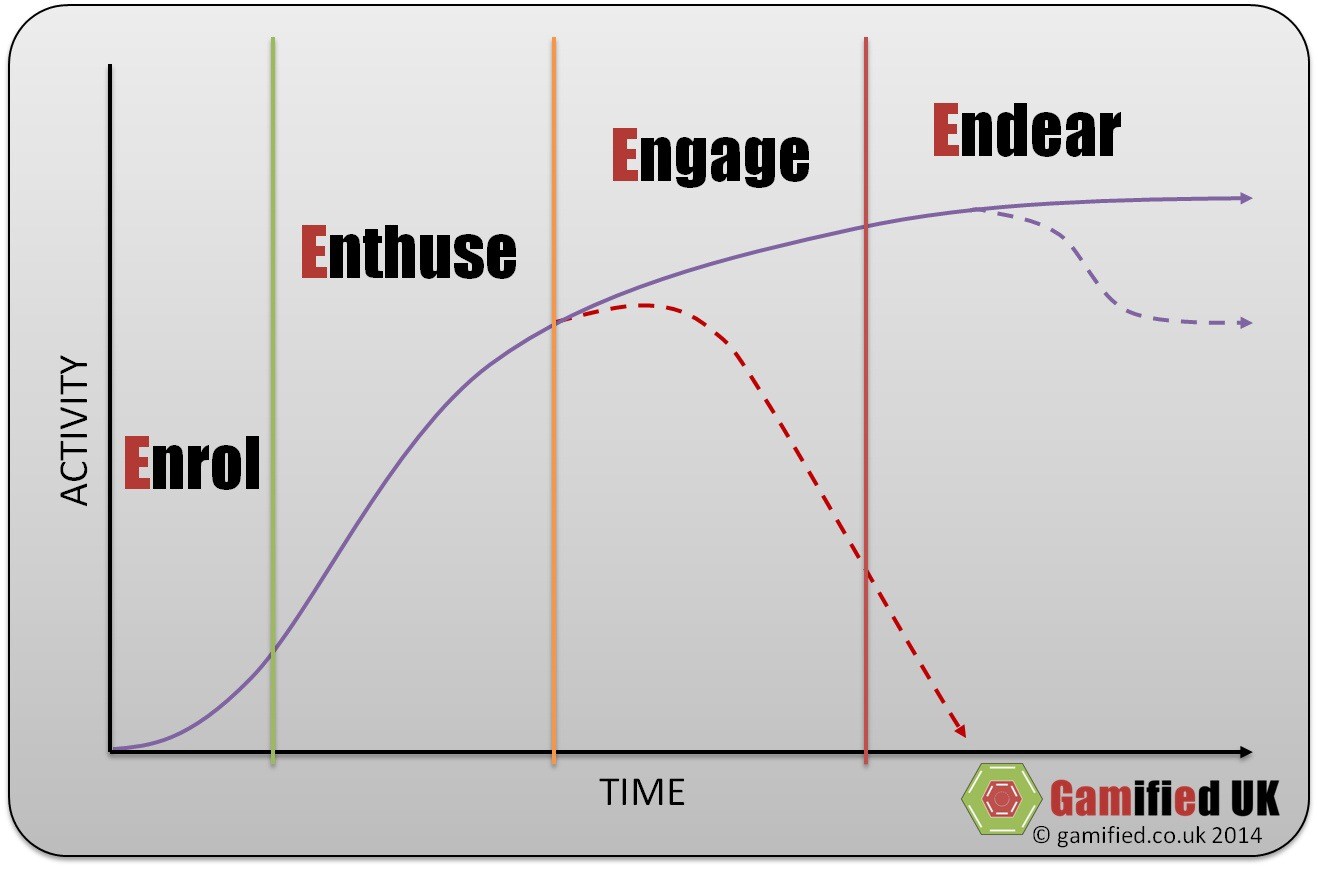
The EEEE User Journey Framework

20140501 205118 The EEEE User Journey Framework

Over the past weeks as I have been re-writing chunks of my book and preparing for various talks, I have been trying to consolidate a lot of my ideas. This has so far lead to four basic frameworks.

RAMP, GAME, EEEE and User Types. There is a big infographic at the end of this post that goes over them, but in brief

RAMP: My intrinsic motivation framework that I have spoke about before. Relatedness, Autonomy, Master, Purpose.

GAME: An update of my original development process framework. Gather, Act, Measure, Enrich. I will speak about this in the next blog post. Read More ...

Looking back at my life – Computer games are in there!

Jedi logo decal 87463 Looking back at my life 8211 Computer games are in there

As I turned 36 yesterday, I started to reminisce a little about what things have helped define my life. I am not talking about family or friends, but actual things.

The first that came to mind was Games, more specifically video games. Now, I am too old to be a millennial – so I of course have not had computers in my life since I was born. However, I have had computers in my life from pretty much the first memories I have – and that is around 4 or 5 years old.

First we I remember us having an Apple II and playing Star Trek with my dad. After that it was a ZX Spectrum+ with a Micro Drive. My dad had only a few games for this, but I strongly remember Ant Attack – one of the first survival horror games!. Somewhere around this time I discovered my dads Acetronic MPU 1000, This was my introduction to multi-player games as we would spend hours playing Space War, Golf, Tank Plane Battle and Space Invaders. That system came out many times over the years! Read More ...

A look at Wikipedia’s definition of Gamification over the years

Wikipedia logo A look at Wikipedia 8217 s definition of Gamification over the years

Just out of curiosity, I had a look through some of the historical pages on Wikipedia’s Gamification entry. It was an interesting time line of the evolution of our definition of gamification, first added in October 2010 it seems. Take a look. It is interesting to see that it puts emphasis on technology based solution in 2010, which is dropped by 2012. Around 2011 the term Funware is added to the definition. This gets dropped by the end of 2012. 2012 also sees the idea of game thinking entering the core definition as well as engagement (which vanishes for a bit then comes back in 2013!). In 2013 we see the first mention of solving problems as part of the core definition. Also, Nick Pelling starts to get some credit for coining of the wold Gamification. The difinition that first comes up early 2013 remains pretty much intact right up until presnt day (April 2014). Read More ...

Making motivation worse with Gamification

Man with head on desk 300x201 Making motivation worse with Gamification

When people talk about gamification, it is pretty certain the word “motivation” will pop up. “We want to engage and motivate our people, gamification is definitely going to be the answer for that!”.

The trouble here is that gamification is AN answer, not always THE answer.

People lack motivation in job for a number of reasons, often self perpetuating reasons. Whatever their reason, they are often viewed as poor at their job and an irritant. It is easier to view low motivation as an issue with an individual than with the company or setting. Read More ...