Flow, Player Journey and Employee Satisfaction

Slide3 Flow Player Journey and Employee Satisfaction

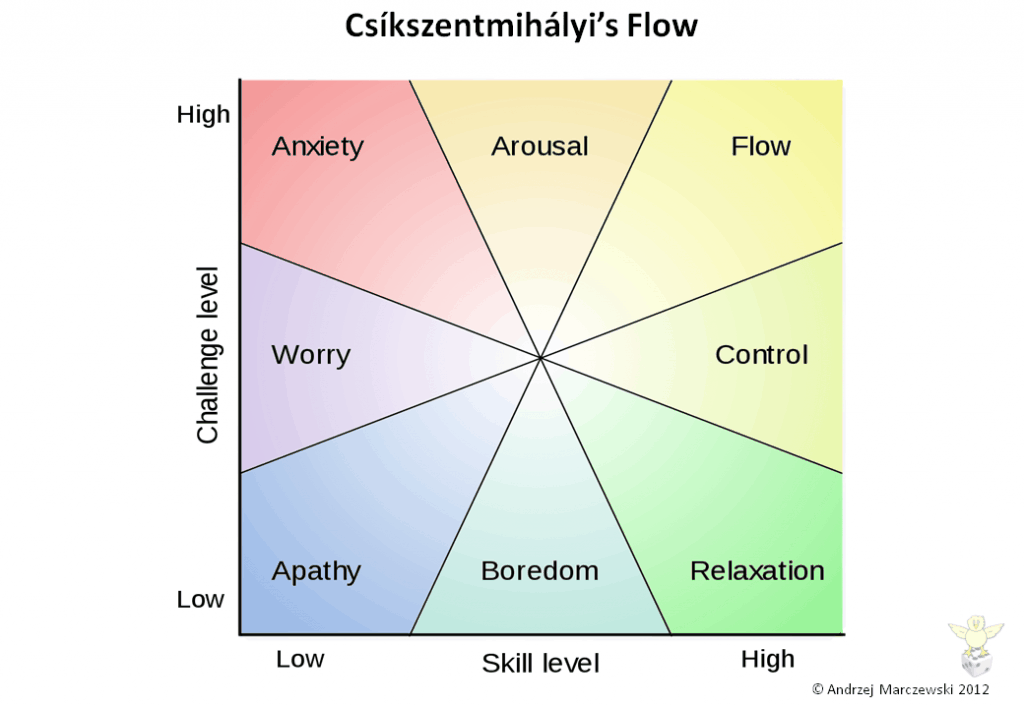
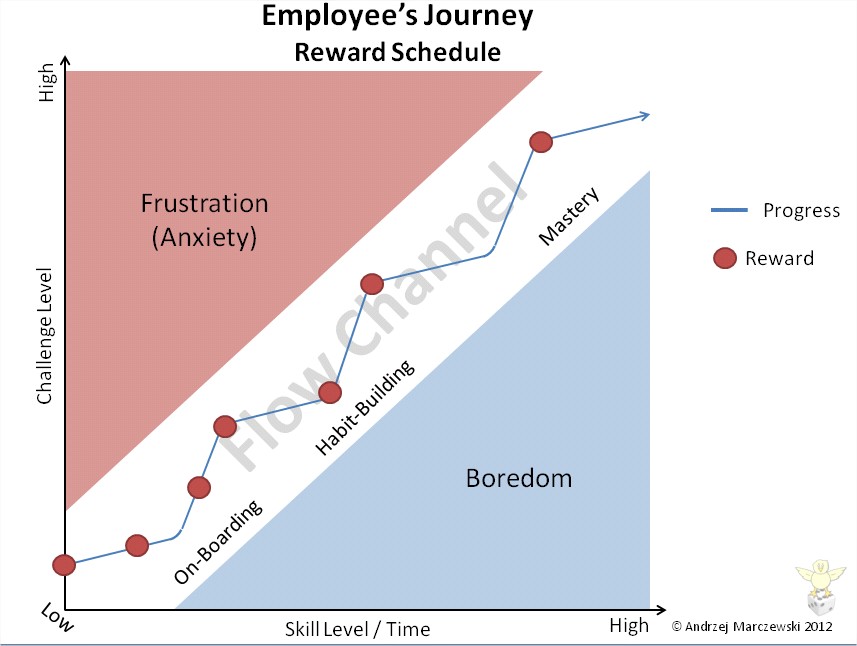
What follows is an exploration of what happens when you start to map player journeys in games onto Flow theory and then try to bring that into the workplace. Just for fun! It was inspired by Mr Scott Golas after seeing last weeks post on relatedness. It may or may not have any worth, but it has been fun to develop. Click images to see the bigger versions or you can see the presentation at SlideShare

What is Flow and what is the Player Journey?

Mihayi Csikszentmihalyi suggested the concept after seeing that under certain conditions people’s experiences became optimal. This is to say that everything around them was lost as they concentrated on the job at hand. This can be seen in many artists who just “get into the grove” as they work. Time stops, nothing else matters and when they finally come out of it, they have no concept of how long they have been working. Read More ...

Relatedness: The Often Ignored Glue of Gamification

1118 BatmanArkhamCity 277 BMInterro3 Relatedness The Often Ignored Glue of Gamification

Another great conversation with my friend Scott Sinclair and another batch of inspiration for a blog. This time about why social is really the key to gamification.

Let us look at one of my favourite video games of all time, Batman: Arkham City. Without going into too much detail, you are Batman and you have to uncover a plot to take over Gotham. For me, this is one of the most complete single player experiences I have ever had.

How Does a Game Progress?

The way the game works is exactly what you would expect from a player journey. You start with very little in the way of skills and abilities. You are taught how to play the game with “on the job” nudges, hints and tutorials. Once you have the basics nailed, you are thrown into your first “boss battle”. This gives you a chance to test your new skills against a proper challenge. Once this is over, you start up the path again. New skills are added, abilities are enhanced, the story progresses and it steadily gets harder and harder. This pattern repeats – learn skills, master them, boss fight, and repeat. This continues until you have achieved a high level of mastery in the game. Then it is all about the narrative, using your new mastery to get to the end of the game and defeat the final boss. Read More ...

Driving the wrong behaviours with rewards.

875413 47541979 Driving the wrong behaviours with rewards

I have written about this whole thing quite a lot already, but I have some new insights based on things I have witnessed recently.

We know that extrinsic rewards are meant to demotivate people when doing anything that is even slightly creative. So why do we keep seeing them being used in gamification and marketing. On the face of it, that kind of thing works well. Offer a reward and ask people to do something simple. Like this, follow that, +1 the other and you can win a book. Low and behold you can get hundreds or thousands of these clicks – great. The question is, how many of these are valuable? What is the goal? If you are trying to develop new and worthwhile interactions and relationships. Does the same person liking everything you have ever written, just to win the prize, have any actual value long term? Read More ...

The danger of extrinsic rewards on motivation – What I learned from my 5 year old

20120211 085538 The danger of extrinsic rewards on motivation 8211 What I learned from my 5 year old

Another quick one, prompted by an interesting behaviour exhibited by my daughter today that taught me rather a lot about extrinsic rewards.

I have mentioned before the research that has been done on motivation in the past by the likes of Edward Deci and the writing of Dan Pink and more. All of them point to the same thing, extrinsic rewards are bad for intrinsic motivation. The basic reasoning is that at some point, no matter how careful you are, the reward will become the reason to do the task. The extrinsic reward replaces the original intrinsic motivation. Read More ...

A Question of Motivation

Red pill blue pill1 A Question of Motivation

A very quick blog this week, whilst I work on a few deeper ones (possibly)

An argument that is pretty constant in Gamification, is that of Extrinsic vs Intrinsic motivation / rewards. Things like badges, points and even money vs altruism, autonomy, status and more. The general consensus, based on the works of people like Deci and talks by people like Daniel Pink, is that extrinsic motivation is in no way better than intrinsic motivation. The research shows that being almost bribed to do stuff will actually decrease your effectiveness. Read More ...