One of the really obvious things that has come out of looking into play and fun, is how resistant us grown ups are to letting go and doing things that seem, on the surface of it, to be of no value.
A framework for creating play-like systems


One of the really obvious things that has come out of looking into play and fun, is how resistant us grown ups are to letting go and doing things that seem, on the surface of it, to be of no value.
A framework for creating play-like systems

Here is something that many who know me or know of me would be surprised to hear. Gamification is not always the answer!
There, I said it.
Often gamification is just a concept people have heard of and know may be of use. In these cases they will ask if it can be used as a solution for an issue they have. The trouble is that it is very easy to fall into the trap of just saying yes. As a gamifier, we really want to use gamification to solve business problems. We know the power that games and game elements can have and want to demonstrate this whenever we can.
Emergence is a well-known concept in game design. Emergent gameplay comes when players interact with the mechanics of the game creating situations that have not been deliberately designed.
This could be part of the game design or it could be unintentional. For instance, the game may offer several tools to solve a puzzle, but allow the player to use them in any way they see fit. If the puzzle requires you to reach an item that is high up, there could be an infinite number of ways to get it. Use a grapple hook, build a tower, make a jetpack and so on.

If you follow me on Twitter, it is unlikely that you will have missed the fact that I love a toy called Rory’s Story Cubes.
For those who don’t know, Story Cubes are sets of dice with unique icons on each face. The basic idea is to roll a set of 9 dice (made up from the various core packs and expansion packs) and then use the sequence of icons to create a story. It can be played alone or as a group and to be honest it is absolutely wonderful!
I have used them as a tool for helping my own creativity, I have used them as part of workshops to loosen up a few minds and of course I have used them for fun and play.
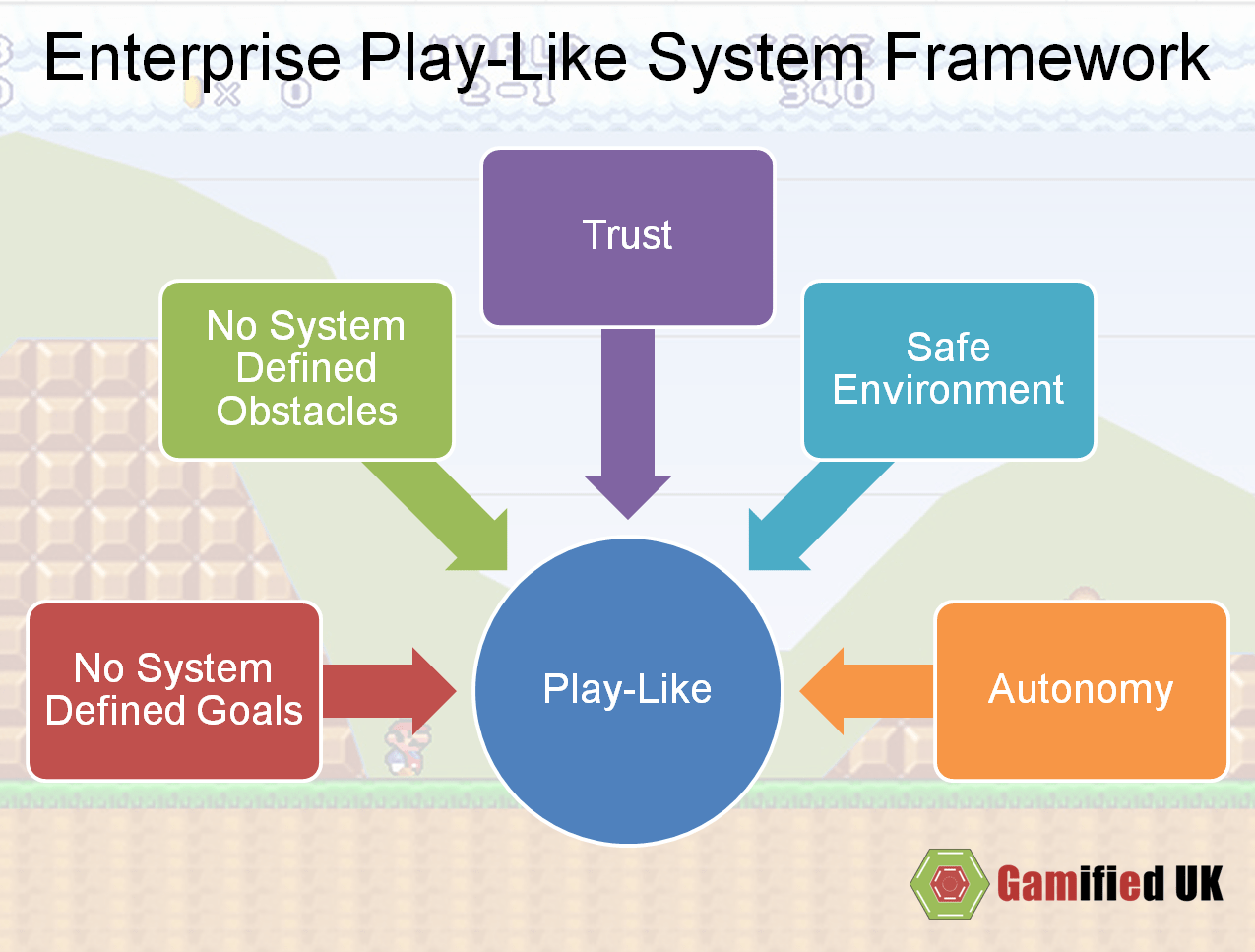
All of this research into play and talking about play has been for a reason. I wanted to try and open up the idea of making more play-like experiences rather than more game-like experiences. I was trying to introduce some of the basics that separate games and play. For this there are three important differences between play and games that we need to keep in mind.
In play, the goals are often less defined or not consciously apparent. Whilst there may be rules that dictate how play progresses (social rules, physical rules and so on), there are not that are there to deliberately challenge you or make things harder.